In the years following the Chautauqua, an event called the Lyceum took a place of community importance. It was a series of speakers and entertainers who presented programs to people in various communities throughout the United States. A splendid thing for a community, but certainly a community effort was required to bring this educational enterprise to town. Churches were now being used for these programs as the old Pavilion at the Camp Grounds had been torn down on March 16, 1922, by the Franke Land Company of Mason City. The season tickets for the Lyceum (usually for four or five events) were sold by schoolchildren from the public schools. The prices for the package of programs were in the $2.00 range for adults, with reduced prices for the younger children.
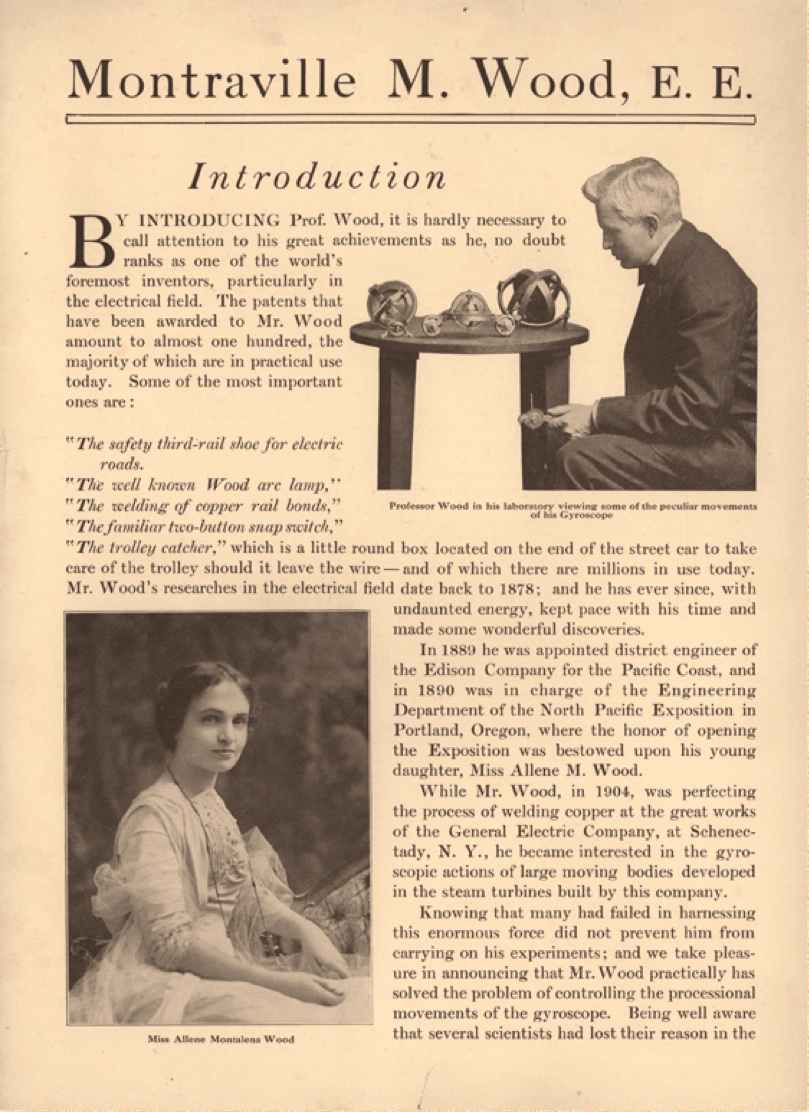
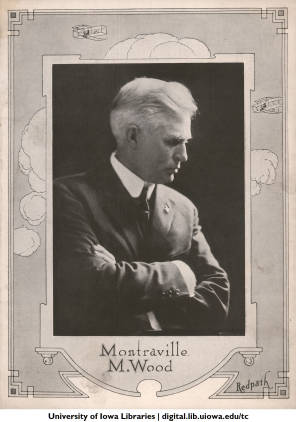
Community businessmen attempted to identify the “stars” they believed would be a good fit for their town. One of the individuals who contributed to the 1922 Lyceum at Clear Lake was Montraville M. Wood. At the time of his arrival in Clear Lake, Mr. Wood was 62 years old, having been born in Leon, New York, in 1860. He was married with one child, a daughter named Allene, who assisted in his demonstrations.
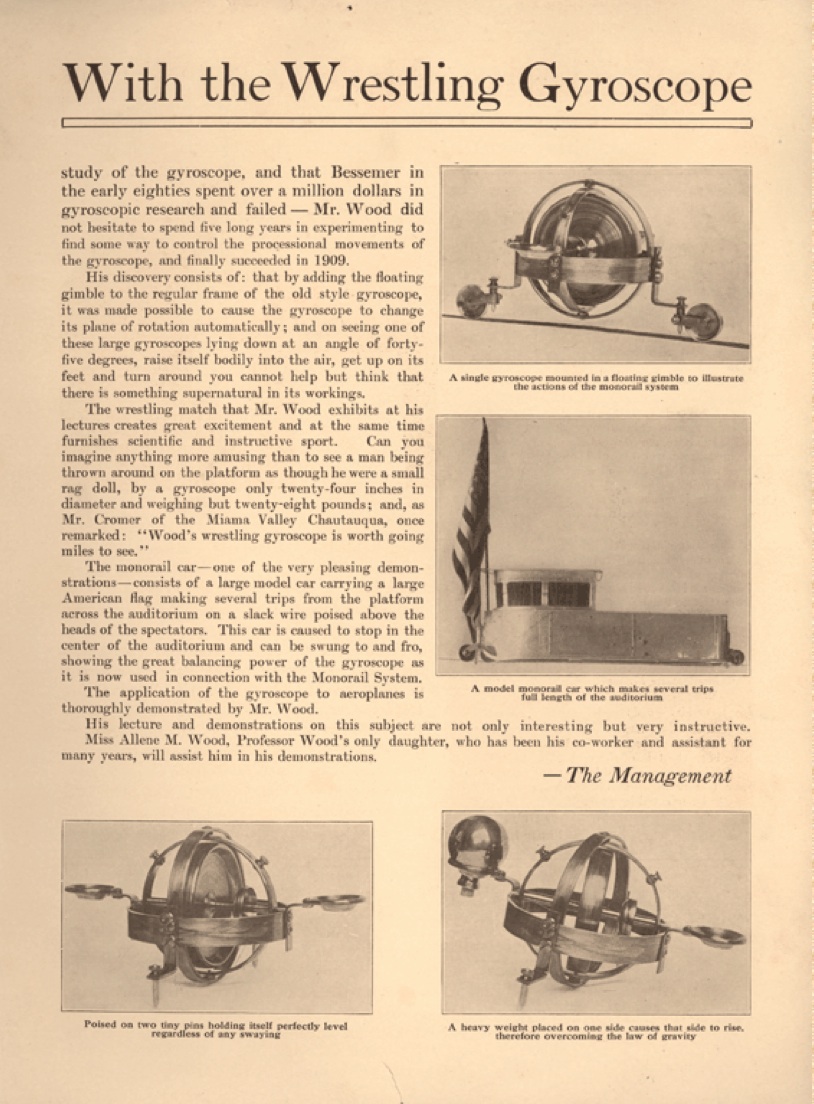
The Clear Lake Mirror reported his program in the following manner: “Montraville M. Wood gives a scientific lecture-demonstration that is delightfully entertaining. He is known as ‘the Scientific Entertainer – the Entertaining Scientist.” See the wrestling gyroscope, try to throw it. Learn of the powerful and mysterious violet ray, how to blow up a submarine with a bugle call, and how to turn on electric lights by merely speaking the word “light” and dozens of other marvelous mysteries that this wizard of science presents.” He spoke at the Clear Lake Methodist Church on Monday, November 27, 1922.
The Mirror didn’t report on what took place at Wood’s performance, but he probably demonstrated how gyroscopes could be used in air travel and also in monorail cars, both very futuristic concepts. There was also a routine that some magicians used, called the “Mighty Cheese,” which involved a gyroscope that couldn’t be pushed over. His discussion of ultraviolet rays might have included their possible use in medicine in the future.
But Mr. Wood was more than a simple magician. He had been an associate of Thomas Edison and served as an engineer for the Edison Company on the Pacific Coast. He had developed some inventions that aided in the transfer of electricity. One of the more notable and practical ones was the two-button electric switch, which can still be found in some historic homes today. He was also a good friend of the Wright Brothers, Wilbur and Orville, who had, of course, created the first flight of an airplane. In fact, Mr. Wood’s inventions were numerous, numbering approximately 100, with eighteen of them holding US patents. He had been appointed the first aerial postmaster appointed by the government to carry mail in an “aeroplane.”
But, for many, scientific speeches were downright boring! So Mr. Wood was quick to spice them up a bit with some entertaining magic. Similar performers on the Lyceum circuit would be called “scientific entertainers.”
His show was entertaining and displayed many of his own innovations. Some could be demonstrated, such as his card tricks and the gyroscope, but others were simply mentioned as future inventions. He spoke of gyroscopes being used for air travel at night and in windy conditions, as well as monorail cars. He probably demonstrated to his audience what he called the “Mighty Cheese,” a gyroscope that couldn’t be pushed over. It was apparent to all that he loved magic and quickly discovered that science could be used in this entertaining way. He had one of the best “rising card” tricks that there ever was. He also described a new type of torpedo and wallpaper that would store enough light during the day to illuminate rooms at night.
Harry Houdini was also a close friend of Mr. Wood. Houdini, born Eric Weisz in Budapest, Hungary, but raised in nearby Appleton, Wisconsin, was always looking for new tricks. And Mr. Wood had a good one! Houdini was eager to learn a new trick to attract customers. Wood called it the “milk can trick,” and he shared it with the great Houdini in the early 1900s. Mr. Wood devised eight methods of escape and shared them all with Houdini. The trick involved what appeared to the audience to be an ordinary milk can. Houdini was handcuffed and sealed inside this oversized can. He invited the audience to hold their breath along with him while he was inside the can.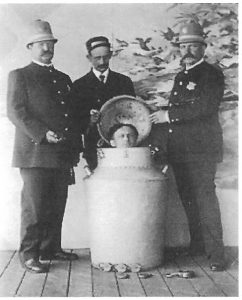
Then water, milk, or even beer was poured over him, filling the can. But it was his creation of the milk can trick that solidified his place in the history of magic. Often, Houdini, always the entertainer, would have a priest and a man in doctor’s clothing standing nearby “just in case.” Houdini bragged that he could escape in just two minutes. But once, in England in 1911, Houdini was overcome by the fumes of the beer that had been poured into the can and momentarily passed out. He had to be removed from the can. Jokesters later said that it was a waste of good beer! Houdini took his milk can act on a tour of several European countries, including England. Houdini was to use this trick as his closing act until 1912.
Montraville M. Wood would die in 1923, less than a year after his performance in Clear Lake. He had made Chicago his home for much of his life, and he died in Chicago’s Cook County at the age of 62. After his death, his inventions continued to inspire Americans. His “hearing torpedo”, for instance, was used extensively in World War Two. Yes, a name largely forgotten, but a man whose gifts have continued over the years, and, yes, he came to Clear Lake.
(Houdini in milk can courtesy of the Library of Congress, Prints and Photographs, LC-USZ62-112435, and the formal photo of Montraville M. Wood in the Public Domain. Additional courtesy to the History of the Clear Lake Chautauqua, J. Francis Kee, June 1939), below Chautauqua circuit flyer about Monataville Wood