
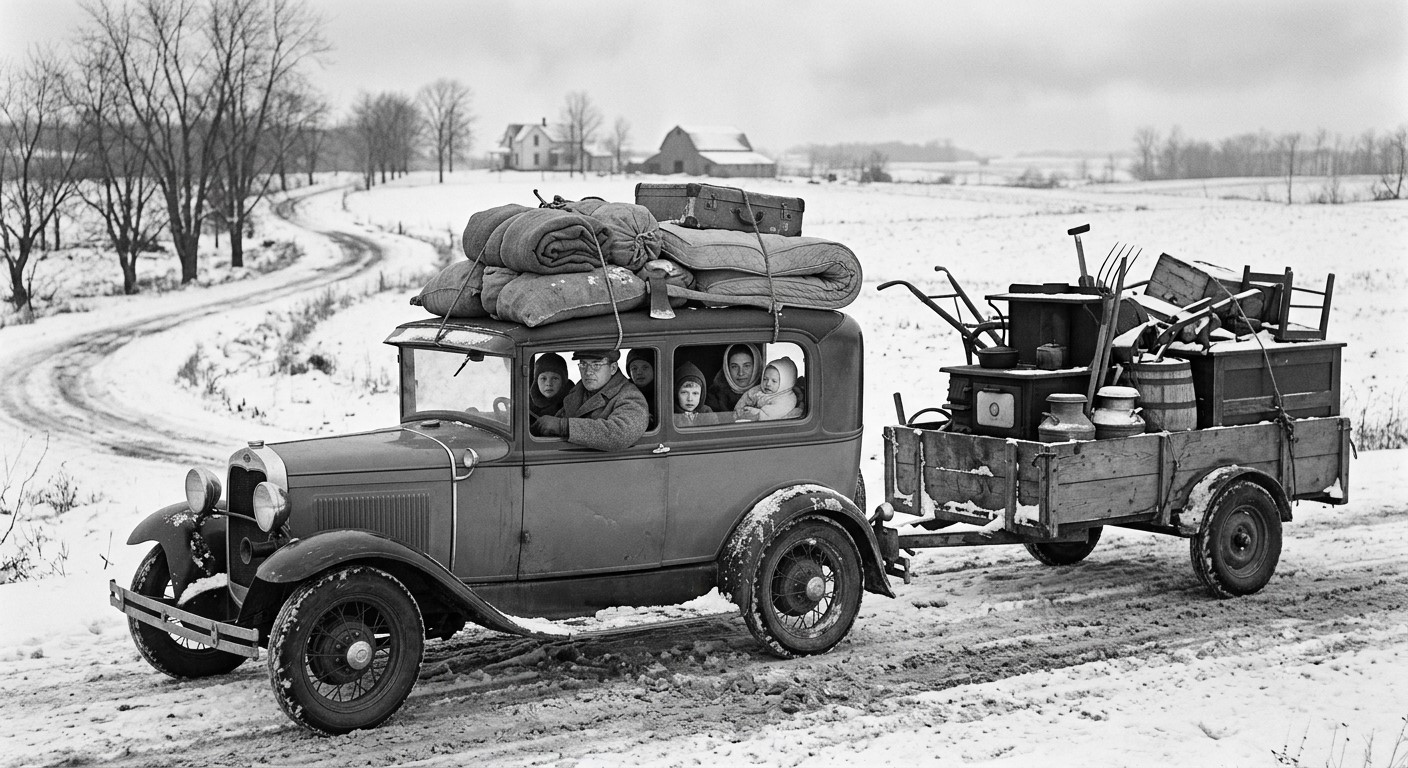
March 1st- that day means different things to different people and at a different time in history it had very special significance as moving day. In eras gone by March 1st was traditionally moving day for farm families and there were lots more of it because many farms were being run by tenant farmers and homeowners in the 20s and 30s. Rich or older land owners would live in town and rent the land out either for share rent or cash rent, a step up I guess from the serfdom and peasant systems of Europe and the families to whom the land was rented would live in the existing house and use the provided barns, etc. for the livestock.
Several weeks ago, in one of the Cerro Gordo programs, author HE. Wilkinson eluded to moving procedures back on March 1st 1899 when his family moved from a farm near Nora Springs to one near Mason City. There was no Mayflower service to call for a free estimate or to make moving easy the Mayflower way as we might suggest. They put all their household belongings and probably their farming implements they had not already moved onto an open hayrack, tied their high wheeled buggy on behind and started out. Thirty-month-old Herbert Wilkinson and his mother rode in the buggy while his father drove the team of horses that pulled the moving caravan to their new home.
My father used to tell about a move their family, consisting of Father, Mother and 6 children ranging in age from Dad the oldest at 10 down to a 6-month old baby, made in March, 1903. They loaded all their possessions, horses, cattle, pigs and dogs, farm machinery implements and household and personal belongings into three railroad boxcars referred as immigrant cars and as such probably got a special freight rate. They loaded at Laurens, IA and the loading itself was quite a project. All the animals except the hogs, “they were too dumb”, were driven into town from the farm 8 miles out into the country. The hogs were hauled in a lumber wagon. They were on the train 1 week and 1 day to go the 450 miles out to Iroquois, SD and they had to take along all the food the animals would need in the week. The family rode in the passenger car while Grandpa and Uncle rode in the caboose of the freight train so they could take care of the livestock. When they got to Iroquois the procedure had to be done all over again only this time they had no one to help them unload and drive the stock out to the farm 4 or 5 miles from the railroad station and there was only the barest kind of shovels working on a farm to which they were moving. There was not even a house on the property, but they came in following bad infestation of grasshoppers in the area and more people had abandoned their homes so they were able to rent a house on adjoining land to move into and live in until a house was built that summer on their land.
Grandpa had bought a half section of South Dakota land for $15 an acre and had traded 6 horses for the first payment. This included an exceptionally fine matched driving team which the land dealer particularly wanted. The family prospered during the South Dakota years feeding cattle and horses and also added another child. Before land seekers came up from Iowa in 1906 and offered to trade one acre of Iowa land for two acres of South Dakota land and Grandpa decided that was a good deal. So once again on March 1, 1907 the family packed up and loaded all their worldly goods into railroad immigrant cars. By this time Dad was 14 year old so he got to ride in the caboose with his Dad and help take care of feeding and watering the animals enroute.
One episode that happened on that move always made a good story. Since Grandma was again very pregnant, in fact that expected uncle arrived on March 5,1907 back in Iowa. She and the children except Dad went ahead on the train. Grandpa and his brother, John who stayed in South Dakota to make his home took them all in to meet the train and were so busy getting them all settled but they didn’t get off the train in time and they had to ride 12 miles before they could get the train stopped to get off. Can’t you just imagine their frenzy? Then they had to walk the 12 miles back near the railroad ties to their place in the February cold. Their horses had been left tied to the hitching post at the depot and were nearly frozen stiff by the time they got back. Meanwhile, 14 year old, Robert (my dad) was home alone wondering what in the world had happened to his dad and Uncle John. But Dad always recalls that trip in the caboose fondly.
Listening and talking to the railroad men along the route was an exciting adventure for one kid who always had lived an isolated life out on the acreage. In his book. In No Time At All, published by the Iowa State University Press, Carl Hamilton had a chapter entitled, “Three Moves are as bad as a Fire”. He tells of moving from Glidden, Iowa to St. Croix Falls, Wisconsin, back to Clay County Iowa and from there back to Glidden all in about 5 or 6 years time. He tells of their experiences like this:
“Three of those five moves were accomplished by rail. Everything we owned, furniture, clothes, lights, stock, machines, tools, the cats, the dogs, everything was loaded on freight cars. Of course, everything had to be hauled in lumber wagons for several miles, then loaded and packed on freight cars along with enough feed for the livestock while they were being in transit. Even our car was shipped by train. Dad would then ride along either in the caboose or one of the cars so he could look after the livestock. When we left for Wisconsin, we had neighbors and friends who helped us load but I’ve often wondered how Dad went about unloading those cars and livestock when we arrived in Wisconsin or at Anita Iowa, a town of about 75 of where we knew not a soul. In the case of Anita, Dad had been there before my sister and I arrived early one morning on the Rock Island train. He met us at the station with a horse and buggy. We started for what was to be home just as the school bus was coming down the road. It was horse-drawn of course; the sides open so the kids were peering out to see what the new family looked like. As the two rigs approached, one hind wheel on our buggy began to collapse. The stock rotten from age and lack of paint gave way one at a time when we essentially had a flat wheel. It was bumping along getting worse and worse making a lot of noise and causing Old Pete, our horse to lead more than ever on the bit. So Dad found the usual farmer remedy. He fixed it with a piece of barbed wire from the fence and tied that broken wheel so that the good side was held in a down position. It functioned as a runner. Under those sorry conditions the kids on the bus met the new kids. I can still remember that morning. It was not an auspicious beginning.
But even on those moves within the same community it was not a thing of calling a moving van with packing quilts and boxes. In the first place, moving started in the fall. There might be snow on the ground on the traditional March 1st moving day and so everyone would start picking them up and bringing them inside or standing up along side the building so they wouldn’t be left behind. March always seemed to come in like a lion in those years in which we moved. Along in January or February there would be relationships with the families vacating the farm to which we were moving. We started moving various items of equipment and machinery. They had to be carefully put aside at the new place so as not to be in the way. As each single day moved closer, packing started in the house and became increasingly hard to find things. The house grew more and more barren as curtains came down, rugs were rolled up and the house began to have that hollow empty ring. Some neighbors would pitch in to help on the final day. It was miserable. The men were never as careful as Mother thought they should be. Everything was loaded in lumber wagons and when things got broken, there was no insurance, just a loss of family keepsakes very often. All this added to the trauma of that much dreaded day.
Dad couldn’t select the new place because the rooms weren’t the right size or the furniture wouldn’t fit or he liked the decorating scheme. The new place was selected because of its farming opportunities and the improvements which meant the barns and cribs and sheds. Moving was always harder on Mother than anyone else. Frequently it was moving into a house where the other family had just moved out. It needed a thorough cleaning before moving in but there was no time. Rugs didn’t fit, curtains didn’t fit, cupboards didn’t fit, and the floors were bare pine boards with quarter inch cracks and painted around the edges. The rugs seldom matched the unpainted areas. There was no hot water until the cook stove was set up and going. Each room echoed with a hollow unwelcome sound. The chill of March was throughout the house.
As I look back on those early days, I think of Mother and Dad picking corn by hand in years when they couldn’t afford to hire help. But right next to that scene in my mind is Mother’s lot at moving time. Throughout her years the date of March 1st is always the subject of some comment on her part for those poor people who have to move, the sight of a load of goods and machinery going down the road brought thoughts of memory which I am sure was her most unhappy life.”
Carl Hamilton’s reference to March always seeming to come in like a lion rather than a lamb on years when you had to move is an inspiration for our music break today.
March 1st was an exciting day in the rural schools back in those moving days. We were so sorry to see one family leaving and so excited to see what the new one would be like and if there would be any kids your age. In an eight grade rural school you always hoped there would be some new kids for your grade. Having one or even two in a class was a drag. You had to know all the answers to all file questions. I remember one memorable March 1st when a Dutch immigrant family moved into our district. The mother and father could speak no English and the children had a strange dialect we thought but I loved taking to Wilma who was my age and helping her and listen to her exciting stories about Holland, the boat to America, being in New York City and all the exciting things we stay at home kids had never seen.
Another March 1st move I vividly recall happened back in 1936, again from South Dakota and back to Iowa only this time it was my own family moving. Dad had remembered this family’s South Dakota years fondly and when the opportunity to move to Dakota to a much larger than the one in Iowa he was renting came up in 1926 and he decided to make the move. It would have been great, probably, except for one thing. He happened to choose an era in time when a severe drought and a severe depression coupled together to make farming in 1935, especially in South Dakota, a nightmare. We raised enough crops to feed the animals in 1930 and 1931 but in 1932, 33 and 1934 we raised nothing. And I mean nothing except weeds and thistles! Finally in 1935 a few rains begin to revive the stricken land somewhat. Iowa had not suffered nearly so disaster from the drought and when the opportunity to return to Iowa presented itself in 1936 the folks decided that they had better take advantage of it and get out when they had a chance. And so we moved.
Anyone over 50 remembers the winter of 1936, there was snow, lots of it. We were scheduled to move to Iowa on February 1st. For a solid month blizzards, blocked roads and frigid temperatures kept us in South Dakota. We lived with dishes, pans and clothing sitting around in boxes. Dad would scoop out the driveway a quarter of a mile to the highway. Before we could get loaded and gone another storm would hit and he had to do it all over again. Fuel supplies ran low, grocery supplies were scarce and there were weeks when even our rural schools closed.
Finally, by the 2nd of March it was possible to get scooped out for the trucks to get into the yard. We had moved the machinery in the fall so it was only the household goods and the animals to move. The whole day was spent packing and cleaning up the house. We had supper with an aunt and uncle and then we started for Iowa in a Model-A 4-door sedan. Dad was anxious to get to the Iowa farm before the trucks with the animals arrived the next day.
As the winter of 36 had been equally rough in Iowa he knew there was lots of snow to be moved as no one had lived on the place since November. It was a wild trip. Most of way, we drove between snow banks higher than the car. We had had several melting days and the road was covered with water. Because of the snow banks there was no place for the water to run. It was just cold enough for a thin layer of ice to form, and the car would have to break through it. We had no heater but with 5 of us in the small car for about 10 hours, keeping warm was not a big problem. We couldn’t stand it today probably but we were used to it and dressed for it. We arrived at Spencer Iowa after driving all night to stop for breakfast. The car was a sight to behold. The wheels were so full of ice that there was only a tiny space around the hub caps. People gathered around the car wondering where we had come from and how far we had driven. We checked and discovered they had started opening the country roads only the day before. It seemed some doubt whether the roads from Highway 18 down to the farm had been opened yet.
We drove out to Dickens and were told we could probably get 7 or 8 miles south but it wouldn’t be a direct route. We seesawed back and forth, sometimes in the road and sometimes in the field but the old Model-A made it through. We did arrive 7 or 8 hours before the trucks. With their heavier loads, they had no trouble and came through in fine shape.
Unlike Mrs. Hamilton’s unhappy moving experiences with broken and damaged household goods, we had only one broken dish and the horses and cattle we had moved weathered the move in good shape. Dad always prided himself on being a good horseman and was particularly worried about the horses. The trucker stopped halfway at a sales barn to exercise them and feed them before reloading them for the rest of the trip. I don’t even remember any conversation about the rest of the animals. We kids were worried about our old dog, Shep, because we had heard stories about how they could find their way back to their old home even if it was a long, long way. But I guess Shep knew he had a good thing when he got to Iowa because he surely never tried to go back. Some friendly Iowa neighbors with tractors and snow scoops came shortly after we arrived to help get the snow cleaned out so the trucks could get into the barnyard when they arrived.
I don’t think I’ll ever forget how bleak and sad the old unlived in farmhouse looked on that very cold March day. My mom probably felt like crying. She had never seen it, so she had no idea what to expect. But the truck was arriving in a few hours and there was too much to be done to spend any time crying. You rented a farm for the quality of the land and the amount of acreage and took the buildings and made do and believe me good farm houses were not top priority on a landlords’ list. At some time in the future I’ll tell you about that old farmhouse so you can look around and count your blessings when you view the comforts provided in a 1980 style abode.
This poem by Helen Lowry Marshall on the art of making do is a favorite of mine because it reminds me of my own parents.
Making Do
When we were young we never knew what it was to be poor
But now I know the old wolf must have camped beside our door.
But those frustrations caused by lack of wealth we never knew
For very early we were taught the art of making do.
We learned to use the things we had plus our imagination
And what a wealth of happiness we found in our creation.
We watched our parents use the art a craft they dignified
With ingenuity that said watch our honest family pride.
And that resource we learned has save us well these years
Belief in one’s owns power tends to minimize life’s’ own fears.
Our children have a great deal more than we as youngsters knew
But they’ve been cheated of the art and sign by making do.
Moving day is no picnic even with Mayflower, Allied, or North American or whoever’s expertise to assist you. The next time you have to move or assist a family member or friend in moving think back to when a family who was moving to a farm home and no heat until the cook stove or heating stove had to be attached to the existing chimney flue, the fuel located and a fire started. No hot water, there might even have been no water if the pumps were frozen up, there was no light until the boxes with the lamps were found and unpacked. There were no rugs on the floor or curtains left at the windows and probably the men were so busy getting animals situated that you had very help from the. People talk fondly about the good old days but March 1 st moving day was certainly not high on the list of favorite things a farm housewife would remember. That’s part of an era gone by, thank heavens so we can recall and enjoy those early experiences as we once again remember the way we were.