
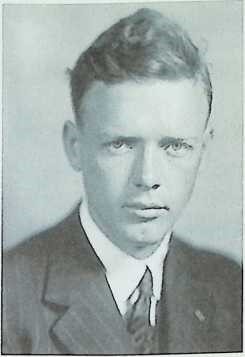
The Clear Lake Mirror headline on September 1,1927, proudly read, “Lindy Drives ‘Miss Betty;’ Boat Races at Bayside Drew Large Crowds.” Most Clear Lake residents certainly knew who “Lindy” was. Earlier that same year, Charles Augustus Lindbergh, at the youthful age of only 25, had flown across the Atlantic Ocean on a non-stop solo flight in his plane, “The Spirit of Saint Louis.” He became an instant international celebrity and was nicknamed by the American people to be “Lucky Lindy.”
But what had brought Lindbergh to north central Iowa? He had been invited by Colonel Hanford MacNider, originally from Mason City, who was, at this time, the U.S. Assistant Secretary of War, having been appointed by President Coolidge. Lindbergh wanted to see the famed Selfridge Flyers perform at the local airfield. This was a crack Army flying team. After inspecting the planes and even flying one of the planes in a demonstration of skillful maneuvers, he jumped into MacNider’s waiting automobile and came to Clear Lake for dinner and an overnight stay along the lake in the MacNider cottage. Lindbergh was welcomed by all and was easily recognizable with his big, boyish grin
In John Perkin’s book, Of Frogs and Friends, the long-time Clear Lake resident speaks of this overnight stay and a boat incident. It seemed that a friend of Perkin’s, Pete Petersen, was working for Colonel MacNider at this time with his job being to mainly pilot and maintain MacNider’s boat, the “Miss Gretchen.” It was, however, the “Miss Betty”, a speed boat owned by Pete’s older brother, Verne Petersen, that caught Lindbergh’s eye. It had a large engine and could go upwards of 40 miles per hour. According to Perkins, Lindbergh had never piloted a speed boat before and asked if he could pilot the “Miss Betty.” Of course, who could say no?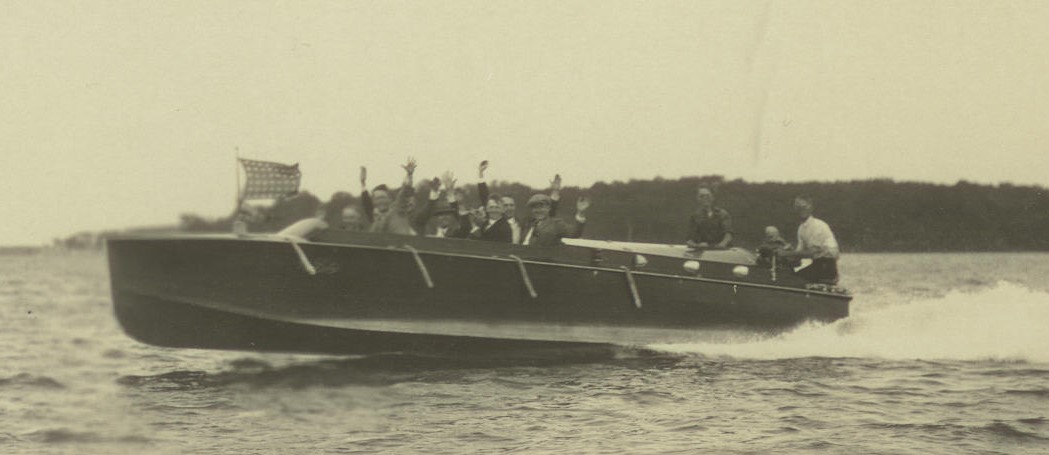
Perkins continued, “After a few minutes getting the feel of the wheel, he turned to Verne (Petersen) and asked, ‘Will this boat turn over?’ Surprised by the question Verne answered, ‘No, I don’t think so.’ “Lindy eased the throttle ahead to full power and spun the wheel for a sharp
turn. The agile boat heeled high, exposing its bottom to the horror-stricken observers on shore but it stayed upright. Lindbergh, satisfied, turned the wheel over to Verne for the rest of the ride.”
Several of those present expressed a bit of shock at what had transpired but none were the worst for wear after the experience. But perhaps they would not like to have it repeated. Lindbergh himself was pleased with the ride and the burst of speed and also with his visit to Clear Lake.
Born in Detroit in 1902, Lindbergh was a Midwesterner himself, and named Little Falls, Minnesota, as his childhood home. He studied at the University of Wisconsin for a period but soon the lure of flight took over his life. He joined the U.S. Army in 1924 and trained as a pilot.
It was on May 20,1927 that he made the record-breaking flight from New York City to Le Bourget Field in Paris. A crowd of 150,000 French citizens stormed the field when the plane landed. The flight had taken twenty hours and twenty-two minutes.
Later, in the same year he had been in Clear Lake, he was in Mexico where he met the daughter of the American ambassador, Anne Morrow. They married in 1929 and later taught her to fly.
On March 1, 1932, the Lindbergh’s 20-month-old son, Charles Jr., was kidnapped from their home in New Jersey. The baby was later found dead. It was a sensational event in America, some calling it the crime of the century, with the man charged with the death later being convicted and executed.
There was also controversy in Lindbergh’s life as America approached the Second World War. He formed a group that opposed entry in the war and was publicly denounced by President Roosevelt. Many called him a Nazi sympathizer. It intensified when he was presented and accepted a German Metal of Honor that was given by Hermann Goering. After Pearl Harbor and the United States entry into the war, Lindbergh went to the Pacific war arena as an advisor and, in 1944, did fly about 50 combat missions. After the war, Lindbergh toured the Nazi concentration camps and wrote in his autobiography that he was disgusted and angered.
After the war he and his family lived in Connecticut and Lindbergh continued to travel as a consultant to the Chief of Staff of the United States Air Force and also to Pan American World Airways. He spent little time with his wife and their children. In 1954, and on the recommendation of President Eisenhower, Lindbergh was commissioned a brigadier general in the Air Force Reserves.
In later years, he became very interested in the conservation movement. He worked to protect endangered species and helped establish the Haleakala National Park in Hawaii. He died of cancer in 1974 at the age of 72 and was survived by his wife and five children and was buried on
the Hawaiian island of Maui.
But, quite unfortunately, the Lindbergh story did not end with his death. In 2003 a German woman, Brigitte Hesshaimer, claimed that Lindbergh was the father of her three children and they had lived a secret relationship. Later, two other German women claimed Lindbergh as the
father of their children. In all, seven German children were born to Lindbergh and these three women between 1958 and 1967. Ten days before he died, Lindbergh wrote to each of the three women, asking them to maintain the secrecy regarding their relationships. But, as time went on, the secrets were no longer kept secret