
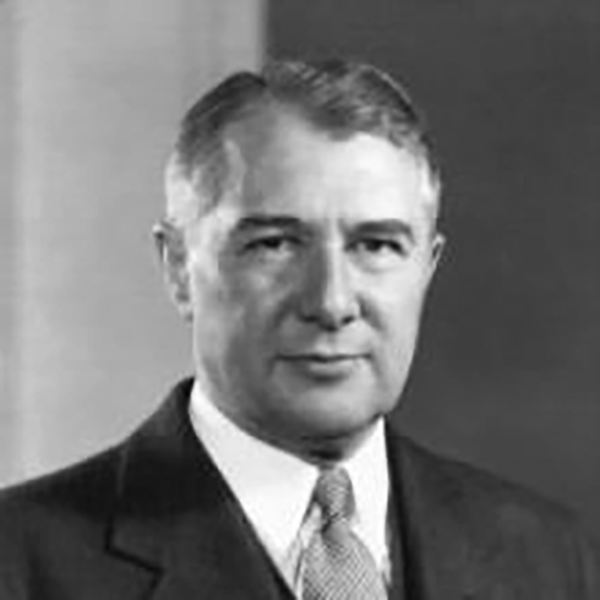
For fifty years the name “Hancher” has been synonymous with fine entertainment in the university town of Iowa City. But many might not be aware their fine arts auditorium was named in honor of the thirteenth president of the University of Iowa, Virgil Hancher.
Clear Lake may have been rather familiar territory for Hancher, having been born in 1896 on a farm in northwest Iowa near the town of Rolfe in Pocahontas County. This county in only a couple of counties to the southwest of Cerro Gordo County where Clear Lake is located. Hancher came from a close-knit family but decided, in 1914, to venture out into the world and enter the University of Iowa (then called the State University of Iowa). It was a difficult time for America with the world war just beginning in Europe. Tensions ran high.
During his first days on campus, Hancher befriended another young man originally from Mason City named W. Earl Hall. The two young men became close friends and their lives were intertwined from those days forward. Hall would later recall that they were “close as brothers.” The joined the same social fraternity, same professional fraternity, same literary society and were even roommates for a period of time.
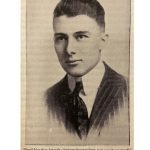 Hancher received his BA degree in 1919 and his Juris Doctorate in Jurisprudence in 1922. He was then selected as a Rhodes Scholar to study in Oxford, England. But the summer before he was to leave for England, he spent in Mason City with Earl Hall and his family. Earl had gone into the journalism field and would one day be an editor for the local newspaper, The Globe-Gazette. But this summer they were just twenty-six-year-old men and trips over to “the lake” were probably frequent. But an important part of the summer for Hancher was having his first experiences in the legal profession by spending time in the office of Blythe, Markley, Rule and Smith. This, of course, was the legal firm instrumental in bringing the famous architect, Frank Lloyd Wright, to Mason City to design a hotel, bank, and legal offices. When Hancher returned from England, he worked for legal firms in Chicago and Washington, D.C. and, in 1928, Hancher married Susan Cannon at her home in Paulina, Iowa.
Earl Hall was serving on the Iowa Board of Regents in 1940 when a vacancy developed for the presidency of the University of Iowa. The first-person Hall thought of was Virgil Hancher. Hancher had many sterling qualities that the Board of Regents was looking for. He was an articulate speaker, a great listener, easily controlled his temper and even had a profound understanding of the Bible. People would later say that Hancher could have been a great governor or senator for the state of Iowa. He understood politics and handled the state legislators with respect. Based on his relationship with his own parents, he understood the term “loco parentis” and was considerate of all students at the university, especially those who dealt with problems along the way.
So Earl Hall then approached his old friend about returning to their alma mater as its president. Hancher had been a recent head of the Iowa Alumni Association so was very familiar with the recent advances the university had made. At this time, Hancher was living in Evanston, Illinois After much consideration, Hancher and his wife, Susan, decided to take the position and move back to Iowa City. The family at this time included a son and two daughters; Virgil Jr., Mary Sue and Priscilla.
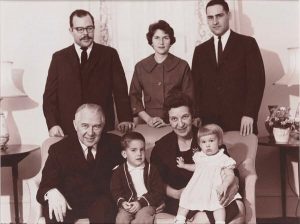
Just before they made the move, tragically, little Priscilla died of leukemia. It was a tough time both personally and professionally as America was staring World War II straight in the face and many decisions would be made in the next few years. This was the beginning of a twenty-four-year career as President at the University of Iowa from 1940 until 1964.
As part of his duties in the early years, he would often venture into various parts of the state and neighboring states to promote the University. In April 1947, for instance, he was the speaker at career day in Eagle Grove for students from North Central Conference. His topic was “Looking Forward.” That same year, Hancher spoke at the July Governor’s Day in Clear Lake, taking part in church services at the lake front. Hancher spoke in August 1949 at Clear Lake’s Bishop Morrison Camp and in January 1951 at the Iowa Alumni dinner at the All-Vets. This visit was sponsored by the SUI Club of Clear Lake. The local group had invited in graduates and attendees from the University from a seven-county region, including the counties of Cerro Gordo, Franklin, Floyd, Worth, Hancock, Mitchell and Winnebago. Over 800 invitations were sent. The cost for the country style chicken dinner was $1.75 and held at the A. V. S. C. (All Veterans Social Center). Following President Hancher’s address, recent movies of the campus and also some movies of the 1950 football team were shown.
Virgil Hancher, during the years surrounding his visits to Clear Lake and the neighboring region, was a promoter of more funding for the University in these years following the WWII. The university was trying to provide educations for the numerous young men and women who were returning to college following the war. This was a period of huge growth for the University of Iowa. In 1952, Hancher was named the head up an American Council on Education committee what examined government research grant for universities in the sciences. Hancher was also a leader in developing a more well-rounded liberal arts curriculum for the university. It was also during his time as president that the hospital school for handicapped children received its funding. He was also a firm believer in the arts and it was his vision for a large theatre on the campus.
Just months following his retirement from the university in June 1964, Hancher accepted a position as a consultant in higher education for the Ford Foundation in India. Hancher had previously made a trip to India in 1949 and met with Nehru, the Prime Minister. It was here, in New Delhi, in January of 1965, just months after arriving, that he suddenly died at the age of 68. He had made plans to return to Iowa and join the law faculty but that was not to happen. Virgil Hancher is buried in Iowa City.
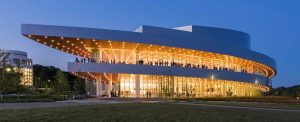
But for many of the students who never knew Hancher as president, his name is immortalized in the Iowa City performing arts auditorium that bears his name. The “first” Hancher Auditorium opened in 1972. This building, close to the Iowa River, flooded in 2008, but has been rebuilt on higher ground but still close to the river, and will entertain students and all of Iowa for years to come.
Portrait photo courtesy of University of Iowa Law Library; family photo of the Hanchers courtesy of University Archives; young photo of Hancher courtesy of Paul L. Bellus; Hancher Auditorium courtesy of University of Iowa Alumni Offices)