
Toward the end of March as the days begin to lengthen and the sun seems warmer, and seems brighter, there comes a feeling born of women’s instinct that it’s time to begin the spring house cleaning ritual. But these cleaning days are nothing compared with the uproar created in the olden days when mothers and grandmothers had coal stoves with their smoke and ash from all winter and carpet beaters instead of vacuum cleaners that kept the carpet clean. Even the lace curtains had to be washed and carefully stretched to be clean and revived. Ever think about cleaning our own modem homes without the improved products and conveniences we have to help us. This seems like an appropriate time to think back to the differences in homes 40, 50 and 60 years ago.
I realize there would be as many different types of homes as there are listeners today, but I hope you will remember and see in your mind’s eyes some homes you may have lived in and helped to clean in times past.
Today many books and magazines are dedicated to the past of keeping American housewives up on current decorating trends and ideas. Lots of money, effort and conversation are devoted to household decor. As people get to discussing decor of their homes; early American, traditional, Mediterranean or whatever, I remember some of the decorating problems to be worked around in our farm house we lived in during the 30s.
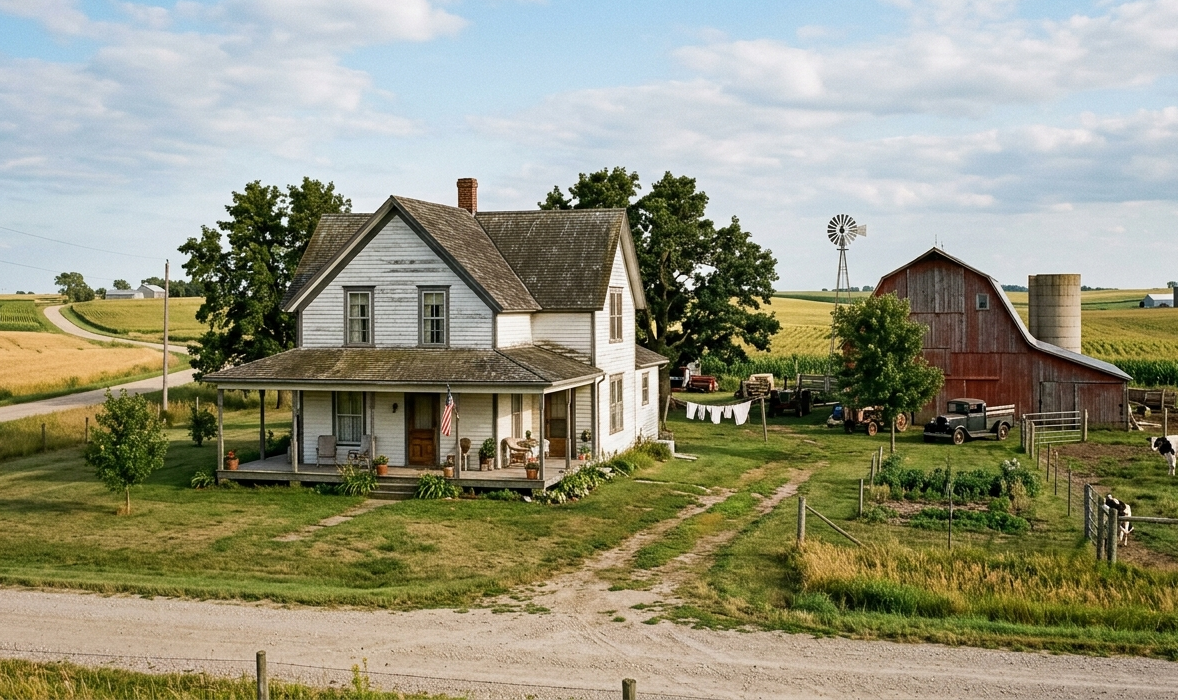
The house had an A-style typical 2-story style with a kitchen and porch probably added after the original house was built. The living room was about 12’ by 15’ with a small bedroom with no closet adjoining at the back. Deep uncovered wooden steps led up to another small bedroom with a large bedroom over the living room. It was a fine productive 240 acre farm which tenant was pleased to be able to rent. However, with this landlord, an elderly gentlemen, had allowed the buildings to become generally rundown, particularly the house.
Houses were usually low priority with improvement plans on rented farms. Houses don’t make money was the theory. I still remember how hopeless and forlorn the old house looked when we saw it for the first time, just hours before moving in. Mom probably felt like crying but couldn’t take the time. The truck loaded with our household furnishing would be arriving from another state in a few hours.
No one had lived in the house for several months and it badly needed some TLC -tender loving care. The floors were old siding with wide boards and chipped off paint in various colors around the perimeter where a 9 x 12 linoleum rug had laid. There was a hideous old wainscoting around the bottom of the kitchen with yellowed icky wallpaper over the top. This was a fairly large room with not one thing in it except a sink with a cistern pump at one end.
Off of this to the back was a pantry and a combination wash house and cob house lean-to which seemed to be about ready to part company from the rest of the house. We soon discovered the pantry was open territory for area mice being conveniently adjacent to the cob house. The front entrance to the house was through a small very ramshackle porch attached to the kitchen. A trap door in the floor of the porch was lifted for steps down to a musty smelly unwindowed dirt floor cellar leading to the contained part of the house. The big rings dominated one side of the kitchen as it had to be set out from the west wall about 5 feet. This was probably for fire prevention and also to line up with the chimney hole. A crude wooden fuel box at one end of the stove added no charm whatsoever.
The old cabinet my parents had gotten when my folks were married was nice. This provided total counter space and food storage. A white zinc counter which could be pulled out was a 2’x5’ of working space. There was a metal flour bin complete with sifter at the bottom large enough to hold a 40# bag of floor behind a long door on the left. Frosted glass doors opened to two shelves at the top which held all the spices and dry groceries. A large section in the bottom part held the pans and drawers along the side held the silverware and tea towels with a large metal drawer at the bottom for bread.
There was no warm milk house or place for the cream separator so that had to be in the kitchen between the cabinet and the table where we ate. I doubt that even the most creative decorator could do much with that utilitarian separator in the middle of the kitchen. The folks had gotten a nice Queen Anne walnut dining room set when they were married. The lovely table with its gracefully shaped legs had to be used in the kitchen as there was no dining room and we needed the space for eating. The beautifully grained walnut top was never visible; it was always completely covered with an oilcloth tablecloth. The buffet was crowded back into a corner by the pantry door. Along with improvised shelves above it held our complete supply of dishes and glass ware.
Soon after they were married in 1930 to 1941 Mom was never fortunate to have a dining room for her nice furniture. Small wonder her advice when we were married was “don’t be in a hurry about getting dining room furniture”. In the wintertime, all the work jackets and farmers’ coats had to be hung on hooks on a board behind the range, a nice warm dry place but they added little to the charm of the room. That was also the only place for all the overshoes. During corn picking, that was for a family of five, a hired man and 2 or 3 corn pickers, so that was quite a pile. Another difficult item to work into and esthetically pleasing decor.
They hung a curtain beside the sink to hide the pail which held the waste water as there was no drain. Right beside the sink in front of a window was a marble top painted commode where we always kept a couple pails of water for drinking and household use. The drawer space held hand towels and roller towels – remember those? And wash cloths. As we had no kitchen sink, the marble top was a convenient place to keep the wash pan for hands and face washing. In recent years, my ambitious sister-in-law had removed the umpteen coats of paint off that old commode. I could not believe it. It was lovely walnut with grooved wood front. How could anyone have covered that beautiful wood with paint? It had been painted when the folks got it as second hand.
In the southeast comer of the kitchen by the door of the living room stood a small oak icebox made in about 1937. It stood there all the year but it was only used with ice about 2 1/2 months out of the year. By mid June the butter got runny enough and the milk soured fast enough down the cellar to justify stopping the iceman who drove a route through the country. He would stop with a 50# chunk a couple times a week. When you lived in the country in the 30s, anyone stopping by regularly was a nice diversion. We enjoyed the firm butter and cold milk but there was one exasperating problem; remembering to empty the water pan underneath. When ice melts, inevitably water runs and when it runs all over the kitchen floor, that’s bad. Our dark linoleum covered kitchen floor got lots of unplanned wiping up as a result. We tried to remember to empty it the last things before going to bed but routine is often difficult to establish. By the time we were really good at remembering the blooming thing, it was September and we weren’t using it anymore.
A further bit of charm in that remembered country system was the old wooden Singer sewing machine with the black metal foot powered pedal at the bottom and 6 little drawers on either side. People use them now as coffee tables or plant stands and give them places of honor in an authentically restored home. Somehow my memory takes back to hours of overalls to be patched and the weeks’ supply of old newspapers. It set under the old crank style telephone that sat inside the front door.
The living room, or front room as we always referred to it, was arranged so that a big heating stove sat in the middle of the room so the stovepipe lined up with the
chimney. It went upstairs through the large upstairs bedroom to bring the only heat the upstairs had. The small downstairs bedroom where my brother and the hired man slept had no heat at all except through the open living room door. It was often so cold that frost would form where they breathed on the covers. The small upstairs bedroom was abandoned as soon as it turned cold. The bed was moved into the folks’ big warm bedroom. We were always happy when the stove could be taken down and pushed against the wall and the bed moved back to its regular place. We would expound on how much larger the house seemed.
Around the comer from the kitchen door stood our big oak player piano which had been in Dad’s family. It was a fine piece of furniture to have and we had a big box of player rolls to enjoy. I wonder now what ever happened to them. There were sliding doors toward the top over the keyboard and this is where the rolls were attached. Then two larger sliding doors beneath the keyboard exposed the pedals which were pumped to turn the rolls to play the music. I’m not scientific enough to understand the principles of the player piano. I just know it was fun and as a youngster I felt I was doing the playing and it was neat. It was fun for the whole family to gather round in the evening and listen and pump and we nearly wore out some of our favorite numbers.
The top of the piano was covered with a piece of dark fringed tapestry. We always referred to it as the piano scarf. A whole assortment of family portraits decorated the top. They ranged from fairly recent vintage to fairly old. We didn’t dare remove anyone. They might come visiting.
The south end of the front room had 2 narrow eight paned windows. Between them sat the heavy oak table with a drawer at the center and space for books on a shelf on each end. The table was where we put our Aladdin lamp for our evening lighting system when we sat in that room. There was usually a plant or bouquet of artificial flowers on a doily on the table also. Two dark oak wooden rocking chairs with handmade cushions flanked the table. The east wall also had two windows plus a door that opened to nothing. The porch if there had ever been one there had long since disappeared. In the southeast comer was the wooden table model radio battery powered until electricity arrived in 1939 sitting on what had once been the bottom part of a kerosene stove. A wooden top and front board had been added and the legs and ends were all painted brown to match. The battery was out of sight inside and it worked very well but it probably would meet no acclaim in the beautiful furniture category.
On the east wall was the lounge – a 1930s version of a davenport. It was leather covered of the brown cracked variety with oak trim and an inclined portion at one end which served as a pillow. I thought it was super old-fashioned and always suggested updating the living room by its removal. But we were into the 40s before a second hand davenport replaced the battered lounge and Dad was not convinced then that it was a necessary change or any real improvement for that matter.
Bedsteads were all metal and there were no box springs or inner spring mattresses. Exposed circular coil springs were used. I remember the folks’ bedstead. It was brown metal with pink roses on a center panel and imitation brown cane on two other panels. Their walnut dresser had a large mirror and five drawers of different sizes down below. The kids’ dressers were small and painted with different colors at different times to go with the young girls decorating urges. Paint was cheap so we could change that fairly often.
The big bedroom upstairs would have provided another decorator’s challenge. The closet consisted of a shelf in the corner with a curtain around it. In the wintertime 5 or 6 big sacks of hand chosen seed com to be used for next season’s planting had to be piled in the comer. It had to be kept safe from freezing and mice and none of those dilapidated outbuildings provided such a secure area. When cold weather arrived so did the second bed from the girls’ bedroom. There was a low slanting ceiling and in the summertime it was miserably hot as there was no attic or insulation by the ceiling. It had been wall papered sometime, obviously years before. The ugly brownish paper was far down on the list of have to do things for refurbishing the old house. What a lift when some light flowered wallpaper finally replaced it. The floors upstairs were even worse that those downstairs. When the new linoleum rug was purchased the floor was so bad linoleum designed to look like oak flooring was laid around the edges to cover the wide slivery unfinished boards.
Curtains in the living room were lace without color. Spring and fall housecleaning were occasional reason for laundering and then stretching them on curtain stretchers to reshape them. They got pretty droopy and the edges were pretty wobbly before replacement was considered. Kitchen and bedroom curtains were more colorful with ruffles or straight panels. Bedspreads were of seersucker in drab colors. I still remember how neat I thought our blue chenille was. I’m delighted to be able to go to farm homes that are tastefully decorated and comfortably furnished as any town home could be. Back in the 30s the decor of farm homes was far, far down on the list of priorities for that money starved populace.
A recent Des Moines Register article discussed the Living History Farms in Des Moines. Farms of the late 1840s and early 1900s were viewed by many, many people last year but reconstructing the past is easy compared with projecting the future. The future’s farmhouse will be underground with an exception of a south exposure. It will be contoured to keep out the sun in the summers and let it in to help warm the house in other seasons. About 2 feet of sod with a covered concrete arched roof and planted with prairie grasses. A large part of the house will be a greenhouse where the family could grow much of its food supply. The kitchen and pantry will become increasingly important as food processing centers. Food caves will be incorporated into the farmstead. Outside a pond will be stocked with catfish to help provide family protein. There might be an orchard or strawberry patch, some hogs and a riding herd making it possible to live in the country and raise a family with farm projects.
Does all of this have a familiar ring to all of you who may have grown up on a farm in the 20s and 30s? It sounds if things have gone full circle and all in our own lifetime. I do have a little trouble visualizing our children and grandchildren canning, gardening, butchering, taking chickens but I suppose they can adjust. One of the most prophets in songs about homes is John Payne’s “Home, Sweet, Home”.
“If tigers and palaces go on me roam, be it ever so humble there’s no place like home.”
Edgar Guest summed up the values and feelings of home in this favorite poem.
Home
It takes a heap of living in a house to make a home
A heap of sun and chattering and sometimes has to roam.
A fore you really appreciate the things you left behind
And hunger for them somehow with them is always on your mind.
It don’t make any difference how rich you get to be
How much your chairs and tables cost, how rich your luxuries
It ain’t home to you though it be the palace of a king
Until somehow your soul is sort of wrapped round everything.
Who needs a place that gold can buy or get up in a minute
A for where there’s home its got to have a heap of living in it.
Within the walls there’s got to be some babies born and then right then
You’ve got to bring them up to be good women and good men.
And gradually as time goes by you’ll find you wouldn’t part
With anything they’ve ever used they’ve grown into your heart.
The old high chairs, the playthings, the little shoes they wore
You heard and if you could keep the thumb marks on the door.
You’ve got to weep to make a home, you’ve got to sit and sigh
And watch beside a loved ones bed, and know that Death is nigh.
And in the stillness of the night, to see Death’s angel come
And close the eyes of her that smiled and leave her sweet voice dumb.
For these are scenes that grip the heart and when your tears are dried
Ye find the home is dearer than it was and sanctified.
And tugging at you always are the pleasant memories
Of her that was and is no more – ye can’t escape from these.
You’ve got to sing and dance for years you’ve got to romp and play
And learn to love the things you have by using them each day.
Even the roses around the porch must blossom year by year
Afore they come a part of thee suggesting someone dear.
Who used to love them long ago and trained them just to run
The way they did so they could get the morning sun.
You’ve got to love each brick and stone from cellar up to dome
It takes a heap of loving in a house to make it a home.