
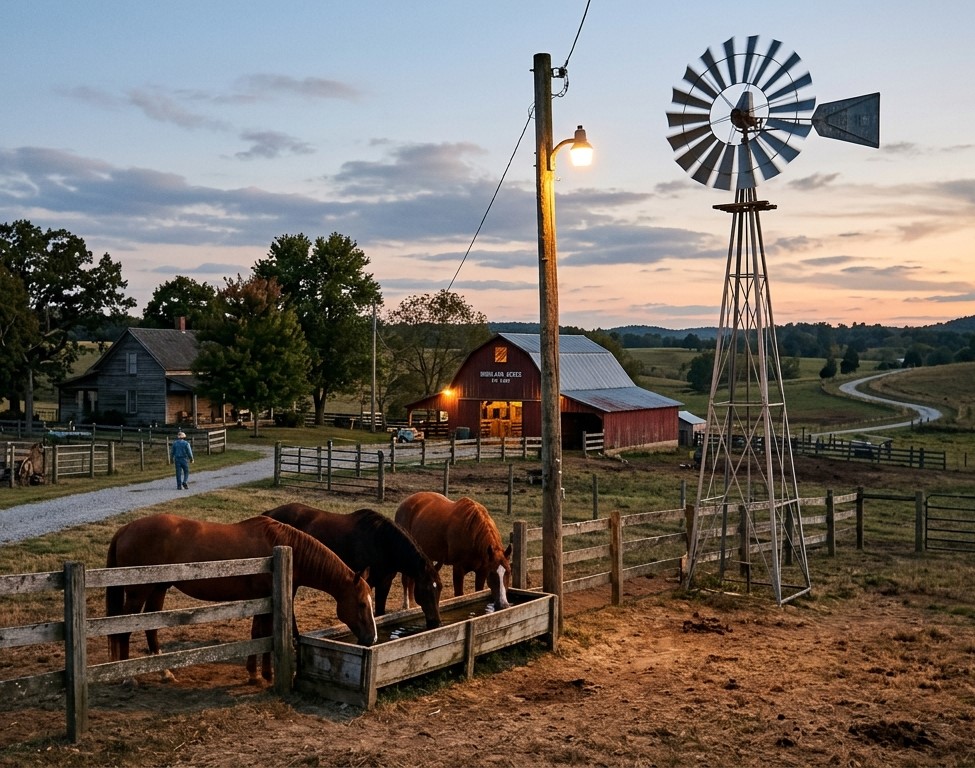
Last week we began a story on energy – from horsepower to automatic to crisis all in 60 years. We visited about horses as a source of energy back when energy was basically horsepower, human emission and fickle wind along with a little kerosene, gas and coal to help supplement the supply. An essential part of every farmstead back then was the towering windmill.
The first one I really remember was wooden. The principle of the windmill is simple. The large round head dealt with blades to catch the wind at the top of a tower tall enough to get the slightest breeze. The wind causes the wheel to turn around and around. It was in turn attached to a pump. As the wheel turned it caused the pump to bring up water from the well beneath the tower. The speed of the wind determined how fast the water was pumped from the well. The wind blew
whether it was harnessed or not. It was an efficient use of available plentiful energy. The difficulty came when the wind for power was not powerful. A hand operated pump was used to pump the pails of water for household use or to fill the stock tank if the calm persisted over too long a period. There was always a big wooden, later metal tank near the windmill to hold water for the horses and cows.
Whenever the wind was blowing, a trough long enough to reach from the pump to the tank was attached to carry the water. It was often the kids’ responsibility to keep watch. When the tank was full enough the pump was uncoupled from the connection to the tall wind wheel.
It was not only wasteful to run the tank over, but it would bring a severe reprimand from Dad because it made a muddy mess when the livestock came to drink. There was usually some low water for the pigs near the well. In hot weather the men made mud holes for them however, because pigs overheat easily. This was a way to keep them cooler. In cold weather, keeping the pump from freezing and the water in the tank unfrozen was a real challenge. Tank heaters, hay and straw insulation and even banking the tank with horse manure because it had a heating quality were all used.
During the drought years, 1930-1935 we lived on a farm in South Dakota and water for the stock became a #1 problem. Many wells went dry just as they did more recently in the 70s and water had to be hauled. On one farm, we lived several miles from a lake. Dad had cut the back off an old Model-T and fixed the box to haul barrels of water from the lake. It was a hard job to fill the barrels and empty them into the tank and back home. Water use was limited and very carefully watched.
During critical times the well would provide enough for household use and drinking and that was about all. We did move to another farm, so for most of the dry years we lived where we had a good supply of deep well water. Having been so critically short made us more appreciative and thankful for it. Hearing about water rationing in California and elsewhere during the 70s we recalled the horrible feeling of being afraid we would not have enough to supply actual needs.
In addition to water, the shortages of the 70s that we hear about was the fuel energy. Natural or propane gas was unheard of in the 20s and 30s. Even fuel oil didn’t become readily available until the 40s. We used coal for the big heating stove in the front room. I have pleasant memories of the big red and yellow flames licking up at the isinglass window in the door of the big heater, casting reflections on walls and windows in a lamp lit room and some not so pleasant memories of burns on exterior parts that brushed too close to the hot stove.
The coal we burned would come on railroad cars to the small town closest to the farm. About November first or as soon as corn picking was finished Dad would either use the old Model-T truck or hitch a 4-wheel trailer behind the car and go to town to bring home several loads of coal. How big a coal bin you had would determine how many loads you could keep on hand. The coal was brought into the house in a metal coal pail designed with one sloping side so it could be poured directly into the open fire.
But coal was used sparingly and except for rare occasions only in the heating stove. It was probably sooty and dirty but it kept us comfortably warm as long as the farm kept being replenished. One advantage of buying hard coal in preference to soft which was cheaper was that it burned more slowly. By banking the fire just before going to bed you could usually manage to keep a fire going until morning.
In minus 20 degree temperatures this was a real advantage. Having a fire go completely out caused loss of precious time in the morning as well as letting the house get mighty frigid. More than once a skiff of ice on the water pail and teakettle greeted the first one up in the morning.
Wood was another fuel we used a lot. An efficient farm family always had a neat looking grove because every dead tree, fallen limbs and even twigs found its way, unfortunately not by itself, to the woodpile. The bigger pieces would be used in the heating stove. Cut up branches were just right for the kitchen range and twigs made great kindling for both stoves. Using wood was an efficient way of using energy you already possessed. It cost nothing except labor and had no other real value.
Cobs were another efficiency fuel item. It cost only the labor it took to either pick them up or take them from the sheller to the cob house. The later was much desired, at least by the cob picker-uppers. The ones you picked up were not clean, but when dry, made good fuel for a hot fire. Realistically they were one step from the buffalo chips our pioneer ancestors had to pick up. Right!!
Kerosene was an energy item we purchased and brought home in 5 gallon cans from town. It was inexpensive and was used for our kerosene and Aladdin lamps and the lantern that was used outside. Everyone is familiar with the kerosene lamp, its kerosene filled bowl, the burning wick and glass chimney. Not so familiar is the Aladdin lamp, a definite improvement in home lighting. It was larger than a regular lamp. Rather than a wick it had a small white mantle. The mantle was very delicate and easily broken but it gave a much whiter light than the yellowish light of the wick lamp. A regular morning task was filling the lamps with kerosene, trimming the wicks if necessary and washing the glass chimneys and I’m sure many of our listeners can remember those tasks.
The lantern was similar to the kerosene lamp except there was a round glass globe rather than a tall chimney. The fuel bowl was metal and there was a handle for carrying it. The globe kept the wind from blowing out the light when outside. It was also a safety feature keeping the light from catching fire with the hay and straw in the barn. The bad features about the farm lantern were its rather small light and the fact that it was impossible to hang it in the right place to be able to really see. You hung it on a hook in the middle of the outside wall behind the cows and you couldn’t see anything from either end; the same way with feeding the horses. There just was never enough light in the right place.
Glenn Miller’s orchestra plays homage to those olden days in his “Lamplighter Serenade”. MUSIC BREAK
Human energy was a very real source of energy in those pre-mechanism days from shocking oats to pitching hay to hand picking corn and all the mundane tasks in between. Wood cutting, snow scooping, post hole digging, manure spreading and cow milking were all hand done jobs. In the house, practically everything was accomplished through human energy. We did have a small gasoline powered Briggs-Stratton engine to run the washing machine, however the rinsing was done by hand. We turned the cream separator by hand, mixed the cake and cookies by hand, washed the dishes by hand, and the by hand list would be endless.
One of the biggest improvements and greatest change to farm life came as the result of a government financed project in the late 30s. It was the Rural Electrification Act which arranged for electric lines to be constructed in all rural areas. It came to our farm in 1939. I wish each person could once in a lifetime experience the thrill our family had when the juice was turned on. We went around turning lights off and on, not believing the difference in brightness and hardly believing that at last we really had electricity. I can’t imagine any future invention that could affect the lives of our children and grandchildren so much.
In Carl Hamilton’s book, In No Time At All, in which we quoted last week, I’d like to share some excerpts from Mr. Hamilton’s chapter about the Rural Electrification, as he worked in that department in Washington, DC and had this to say,
“The Rural Electrification story is in many ways unbelievable. It was actually tough going to push those lines out across the countryside to get people to sign up. A farmer signing up had to put $5.00 on the line. It was a co-op effort and some of his more aggressive neighbors were soliciting memberships from house to house.
Everyone on the line had to sign up to make the loan feasible. Many resisted thinking some kind of hoax; they just couldn’t believe anything could bring light right into their farm home. The commercial power companies had been telling farmers for years that it wasn’t economically feasible to take power lines out across rural areas particularly for such small loads.
The first loans, with a lot of blue sky thrown in, were projected on the basis that farmers might need as many as 75 kilowatts a month. Quicker than anyone could believe it, many farmers were using 1000 a month. It was obviously a rich market. The struggle between co-ops and investor owned utilities took on classic proportions in many areas.
Looking back to at least 4 decades and recalling how difficult it was to sell the idea of electricity in rural areas tells more about the rate and depth of change in rural America than almost anything else that can be recalled or told. Rural electrification did more to change rural America than any other single one thing.”
We had a fixture in the center of each room and not more than one outlet per room, perhaps two in the kitchen. There was an outside light in the middle of the yard and one down by the windmill which were turned on only when necessary.
We drive through the countryside now and lights and security lights on the farm are visible for miles. Men particularly appreciated the single bulbs at several locations in the barn at milking time and when caring for the horses before dawn and after dark.
Gradually we began to turn more and more jobs over to electrical energy. It wasn’t long before an electrical motor was bought to pump the water. It was more dependable than the windmill. Only money kept us from getting more and more electrical gadgets because we were thrilled with new improvement.
In 1941 my folks bought a farm 15 miles south of where we were living. It was a much nicer, bigger house and farmstead in general, except for one glaring deficiency, there was no beautiful electricity, but there were prospects of it coming to the area soon. The refrigerator, radio and any other electrical equipment that we had gotten had to be stored. Out came the old kerosene and Aladdin lamps again.
Somehow, it’s much worse giving up a convenience you’ve had than never to have had it at all. No one was counting on having anything like Pearl Harbor happening in 1941. One thing that had to be postponed was the coming of electricity to the farm soon. There would be a 5 year delay but when it finally came the folks were ready with the house all newly wired and a beautiful new bathroom set. This time instead of just electric lights to turn off and on there were faucets with water running out of them and an electric hot water heater so there was even hot and cold running water. We were arriving at the automatic push button era. It became more automatic with each passing year. New devices and conveniences regularly became available and additions were made as finances allowed.
I look around our home and compare our lifestyle the way we use energy today with the lifestyle of the days before electricity. I’m awed that this could have happened in less than 40 years and in such a subtle and gradual way we were hardly aware of it. I count the things run by electricity in my own kitchen and am appalled to count 13. They range from the fairly essential refrigerator to the strictly convenience can opener and knife and this doesn’t count all the goodies in the other rooms. Multiply that by many homes in America plus industries that didn’t even exist 40 years ago, it’s easy to understand why an energy crisis had developed.
In a recent Ann Landers column in the Des Moines Register she quoted from a letter from an English visitor in the United States as follows,
“There is no place in all the world where laziness and extreme comforts are so expensively encouraged. You people can’t cut a roast without an electric knife. You can’t wash dishes without an electric dishwasher. You must use a blender to whip cream, mix a cake or prepare an omelet. You buy frozen foods that must be kept in a freezer because you were too busy or too lazy to go the market and purchase fresh foods which is much cheaper, more healthful and tastes better.
I’ve never seen so many gadgets in my life and everything is run by electric current. I rarely see clothes hanging on lines in your back yards. Women must use electric washer and dryers and then they must add something store bought to make the clothes smell fresh. Nobody walks and few use bicycles. The meals served in restaurants are double what they should be. Many are overweight and trying to diet. It just doesn’t add up. If your President thinks he can convert the American people to a lifestyle of austerity and sacrifice, good luck to him.”
We are inventive and ingenious people. Our young people need a challenge, love a cause. We must create and will new forms of energy but more importantly we must learn to efficiently use and conserve the energy we have. Someone has said America has two speeds, panic and apathy. This had better not be the time for apathy. Maria Hirschman, the author of a book came from Germany to make her home in America. She was shocked by our waste and believes the Lord sent the energy crisis to wake Americans up to the fact that 6 percent of the world’s population uses 35 percent of the world’s goods. She says we should look upon it as a blessing, not a crisis. God is trying to teach Americans to waste less, appreciate more and thanks for his loving kindness and patience. Not for hunger or war but an energy crisis God is nudging Americans to count their blessings.
Energy and inflation are very real and a 2 prong worry for all of us we begin the decade of the 80s. One wonders what will happen.
Edgar Guest wrote a poem entitled, “Hard Luck” that we might all keep in mind as we think about our troubles.
Ain’t no use as I can see as sitting underneath a tree
Growling that your luck is bad and that your life is extra sad.
Your life is harder than your neighbors knowing harder are your labors.
It rains on him the same as you and he has work he hates to do
And he gets tired and he gets cross and he has trouble with the boss.
You take his whole life through and through why he’s no better off than you.
May I find a man who’ll say he’s never known a rainy day
Or raise his right hand up and swear for years he’s had no care
Has never had a single blow and never known one touch of woe
Has never seen a loved one die has never wept or heaved a sigh
Has never had a plan go wrong and always laughed his way along
Then I’ll sit down and start to find that all the hard luck here is mine.
An unknown author gives us this good advice on how to beat inflation.
Everything is going up.
Well the rain is still coming down. There’s no tax on sunshine and the red and brown of autumn leaves or on the snow that makes a mountain crown.
Everything is going up.
But birds’ songs cost no more. No 20 percent for luxury on the jasmine around the door and moonlight in my garden inexpensive as before.
Everything is going up.
But the price of joy is the same. It cost no more to work or sing a fan of ancient light and to a common smile we may still stake our claim.
Everything is going up.
Come. Come what’s that you say?
The things that really matter cost just the same today.
The broad blue sea, the mountain tops, the trees, the rain, the skies,
they’re tax exempt forever- oh lucky you and I.
Energy from horsepower to automatic to crisis all in 50 years! As we think about the crisis, remember things could be worse.
An unknown author tells us this:
Grandmother on a winters’ day milked the cows and fed them hay.
Slopped the hogs, saddled the mule and got the children off the school.
Did the washing, mopped the floors, washed the windows and did some chores.
Put the dishes home dried fruit and pressed her husband’s Sunday suit.
Slept the parlor, made the beds and baked a dozen loaves of bread.
Cut some firewood and lugged in enough to fill the kitchen bin.
Cleaned the lamp, and put in oil and seed some apples she thought might spoil.
Churned the butter, baked a cake and then exclaimed, “For goodness sake.”
The calves have got out of their pen and went out and chased them in again.
Gathered the eggs, locked the stable, then back to the house to set the table.
Cooked the supper that was delicious and afterwards washed all the dishes.
Fed the cat and sprinkled the clothes, mended a basket full of holes.
Then opened the organ and began to play when you come to the end of a perfect day.
Thank you for joining us.