This history of Clear Lake newspapers is based on articles written by John Perkins for the Globe Gazette and Clear Lake Mirror-Reporter. John Perkins (1912-2011) was a lifelong Clear Lake resident and the city’s ‘unofficial historian”. John spoke to many groups about Clear Lake history and wrote a column for the Globe Gazette about Clear Lake history from 1989 to 1993. He collected those columns along with other Clear Lake remembrances in the book “Of Frogs and Friends,” illustrated by his wife, Marlus. The following article contains an article by John Perkins (writing as Pinsker H Nohj) that was published in the Clear Lake Mirror Reporter on April 18, 1978. This article continues the story of Clear Lake newspapers through the current days. The newspaper mastheads and legal statements from various editions have been added for illustration.

Newspaper history in Clear Lake dates back almost 120 years, reflecting the challenges of sustaining local journalism in a small yet growing community. The very first paper to be published here appeared on Friday, February 10, 1860, under the title The Clear Lake Independent. Its founders, Silan Noyes and John M. Brainard, were listed as both editors and proprietors, taking on the dual roles of shaping the editorial voice and managing the business side of the venture.
At the time, Clear Lake was still in its early stages of development. The town was attracting settlers and businesses, but the population and commercial activity were not yet strong enough to provide consistent financial support for a newspaper. Advertising revenue and subscriptions—the lifeblood of any small-town publication—were apparently too limited to keep the Independent alive.
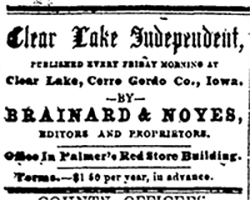 Despite the enthusiasm of its founders, the paper was short-lived. After only a brief run, the publishers made the difficult decision to move their press and equipment to Upper Grove in Hancock County, likely in search of a more promising readership. Unfortunately, the gamble did not pay off. The Independent soon ceased operations there as well, bringing an early but important chapter of Clear Lake’s newspaper history to a close.
Though it failed to thrive, the effort by Noyes and Brainard marked the beginning of local journalism in Clear Lake—a reminder of the determination required to launch a paper and the economic realities that shaped community news during the mid-19th century.

The Clear Lake Observer made its debut under the direction of H. D. Lindley in March of 1869. Although Lindley was ambitious, he had very little capital to sustain the operation. He managed to publish just 15 issues before financial difficulties forced him to sell the paper to George E. Frost. While the Observer itself was short-lived under Lindley’s leadership, the press on which it was printed carried with it an extraordinary and dramatic history.
That press, later nicknamed the “Abolitionary Press,” had once belonged to Owen Lovejoy, a noted abolitionist and brother of Elijah Lovejoy, the martyred anti-slavery editor. In Alton, Illinois, Owen used the press to publish a bold anti-slavery newspaper on the banks of the Mississippi River, directly challenging the prevailing pro-slavery sentiment of the time. His courage came at a tragic cost: he was murdered by a pro-slavery mob, and in their fury, the rioters hurled his press, type, and other printing equipment into the river in an effort to silence his voice.
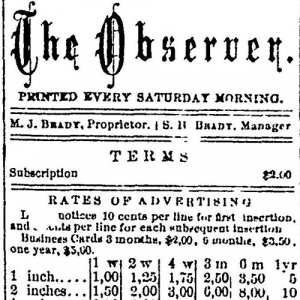 The press, however, refused to be silenced. It was later retrieved from the river and eventually came into the possession of D. B. Mead of Cresco, Iowa. For a time, it sat idle, a relic of both tragedy and resilience, until Lindley purchased it for $35. With this storied press, he launched the Clear Lake Observer, giving new life to a machine that had once been at the heart of the nation’s battle over slavery.
When George E. Frost assumed ownership, he managed to keep the paper alive until 1872. Under his leadership, the Observer aligned itself firmly with the Republican Party, reflecting both the political leanings of many Northerners in the post-Civil War years and the party’s association with the Union cause. However, when Frost sold the paper to Judge M. P. Rosencrans, its political voice shifted. Judge Rosencrans, a Democrat, transformed the Observer into an independent paper, declaring freedom from strict partisan ties. His tenure, however, was brief; after only a few months, the paper was sold once again.
The press itself—by then famous for its abolitionist past—was sold and transported to Belmond, Iowa, where it continued to serve the cause of small-town journalism. Though it changed hands and towns, its legacy as the “Abolitionary Press” ensured that every issue it produced carried with it echoes of a struggle far greater than the boundaries of Clear Lake.

With the March 14, 1879, issue, a new chapter began for Clear Lake journalism. Frank J. Bush assumed control of the paper from George Frost, whose declining health had forced him to step aside after years of steady leadership. Bush quickly made his mark, introducing both editorial and symbolic changes. The most significant was the renaming of the Observer. Beginning with that March 14 edition, the paper bore a new title—The Clear Lake Mirror.
In the very first issue under its new name, Editor Bush penned a short but spirited editorial entitled Salutory. In it, he acknowledged both the legacy of the Observer and the fresh identity of the Mirror. “With this issue,” he wrote, “No. 1, Volume 10 of the Observer, that was, and the Mirror this is, we offer ourselves as a candidate for admission into the editorial fraternity of Iowa.” With this statement, Bush signaled both continuity and change: the paper would honor its past while stepping forward with new ambitions and a stronger identity within Iowa’s press community.
 Although the paper had a new name, its political alignment did not shift. It was announced that the Mirror, like the Observer before it, would remain loyal to the Republican Party, reflecting the prevailing politics of much of northern Iowa at the time.
The Mirror, however, entered a period of frequent turnover in ownership during the decades that followed. After a relatively short time, Bush sold the paper to M. Cooley and Sons, beginning a chain of transitions that reflected both the challenges and opportunities of small-town publishing. Soon after, D. W. Hum acquired an interest, marking yet another change in direction. The ownership would continue to evolve through a series of partnerships: Charles Cooley joined with Eldridge for a time; later, Thomas Gray became a partner with Cooley; and still later, the paper was operated by Cooley and William Gray.
When Cooley finally sold out for good, the Mirror was left in the hands of William “Bill” Gray, who not only kept the paper alive but also held the prominent role of Clear Lake postmaster, tying the press even more closely to community life.
The early 20th century brought still another transition. In 1910, Yost Wallace took over as publisher, carrying the Mirror forward into a new era. Under Wallace’s leadership, the paper began to settle into greater stability after decades of frequent change, continuing its role as Clear Lake’s voice for news, politics, and community affairs.
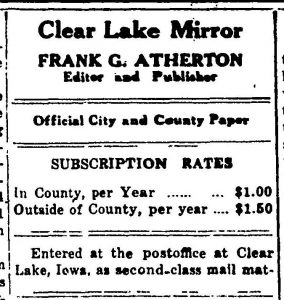
 To bring the ownership of the Mirror into this century, another critical figure entered the story. In 1912, Frank Atherton, who had come from Osage, purchased the Mirror and, together with his wife Millie, began what would become the longest period of stability in the paper’s history. For 26 years, Frank and Millie Atherton operated the Mirror, guiding it through a time of great change in both Clear Lake and the nation. Their stewardship saw the paper through World War I, the prosperity of the 1920s, and the hardships of the Great Depression. By consistently reporting on local news and giving voice to community concerns, they cemented the Mirror as an institution in Clear Lake life.
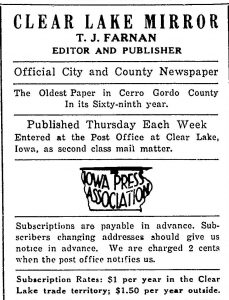
After more than a quarter century of service, the Athertons sold the paper in June 1938 to T. J. Farnan, closing out one of the most significant eras in the Mirror’s long history.

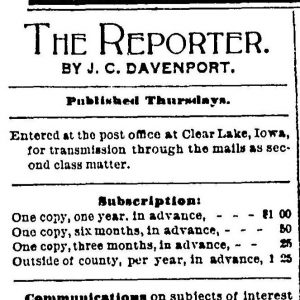
The first edition of The Clear Lake Reporter appeared in 1896 under the leadership of J. C. Davenport. In its opening issue, Davenport published a salutary editorial in which he set forth the guiding principles of the new paper. He wrote, in part: “The Reporter will be orthodox in religion and Republican in politics. It will be conducted in the interest of the masses and never controlled or influenced by any individual, clique, or ‘ring’.” This strong statement reflected both Davenport’s personal convictions and the values of the time, as many small-town newspapers openly aligned themselves with political parties and community causes.
The Davenport family went on to oversee the Reporter for half a century, shaping it into a fixture of Clear Lake life. Beyond the newspaper office, J. C. himself played an active role in the civic affairs of the town. From 1903 to 1911, he served as City Clerk and Water Commissioner, roles that placed him at the heart of municipal development. When he resigned in 1911, it was to accept the appointment of U.S. Postmaster, a position he held until 1915. His civic engagement extended into community service as well: he was a founding member of the Clear Lake Rotary Club, and both he and his wife were deeply devoted to the Methodist Church, where they contributed to both the spiritual and social fabric of the community.
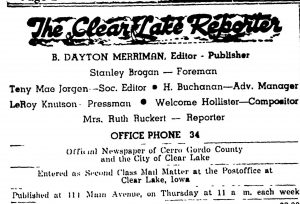
 After 50 years at the helm, Davenport sold the Reporter in July 1945 to B. Dayton Merriman, a newspaperman from Wisconsin. Merriman brought fresh energy to the publication while maintaining its central role in the community. In July 1951, he expanded his influence further by purchasing the Clear Lake Mirror from T. J. Farnan. For a time, Merriman operated both papers, publishing the Mirror on Monday afternoons and the Reporter on Thursday afternoons.
By January 1955, it became clear that the future of Clear Lake journalism lay in unification rather than competition. The two newspapers were merged into a single publication, the Clear Lake Mirror-Reporter, which was issued weekly. This merger marked an important milestone: for the first time in nearly a century, Clear Lake had one consistent, consolidated voice in print, bringing together the traditions of both the Mirror and the Reporter.
 Later that same year, in November 1955, the Mirror-Reporter entered yet another new chapter. It was purchased by William Beck, a newspaperman from Morrison, Illinois, where he had owned the Whiteside Sentinel. Beck was an ambitious publisher expanding his footprint, having acquired the Spirit Lake Beacon. Although he purchased the Mirror-Reporter, he ultimately chose to base his operations in Spirit Lake rather than move his family to Clear Lake. Nevertheless, his acquisition tied Clear Lake’s newspaper to a larger regional network of small-town presses, continuing its legacy as both a local institution and part of the broader story of Iowa journalism.
 By the mid-1950s, the ownership of the Clear Lake Mirror-Reporter had shifted away from local ties. Unlike earlier eras, when the owners were also community leaders and often deeply embedded in civic life, the paper now belonged to publishers whose primary operations were based outside of Clear Lake. The roles of editor and publisher became professional positions filled by employees rather than by resident proprietors.
When William Beck purchased the Mirror-Reporter in 1955, he appointed John Anderson, a trusted associate from his Illinois paper, to serve as editor and publisher in Clear Lake. Anderson relocated to the community, immersing himself in local life and becoming a familiar presence in both civic and professional circles. His tenure provided a sense of stability during a time when ownership was less rooted in the town itself. Anderson guided the paper for a full decade, remaining editor until 1965.
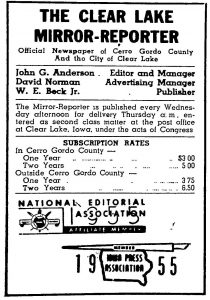 In 1962, Beck sold the Mirror-Reporter to Willard and David Archie, publishers of the Shenandoah Evening Sentinel as well as four other Iowa newspapers. Their acquisition tied Clear Lake’s paper to a growing network of small-town publications. Over the years, their publishing group expanded, and in 1994, the company was formally renamed Mid-America Publishing. Under Archie family ownership, the Mirror-Reporter continued to serve as Clear Lake’s primary news source, shaped by a succession of editors who each left their imprint on the paper. Joe Roth led the newsroom from 1966 to 1970, followed by Don O’Neil (1970–73), Robert Bales (1973–80), and Lyn Hanson (1980–83). Each editor reflected the issues of their time, from the turbulence of the late 1960s to the growth and change of Clear Lake in the 1970s and early 1980s.
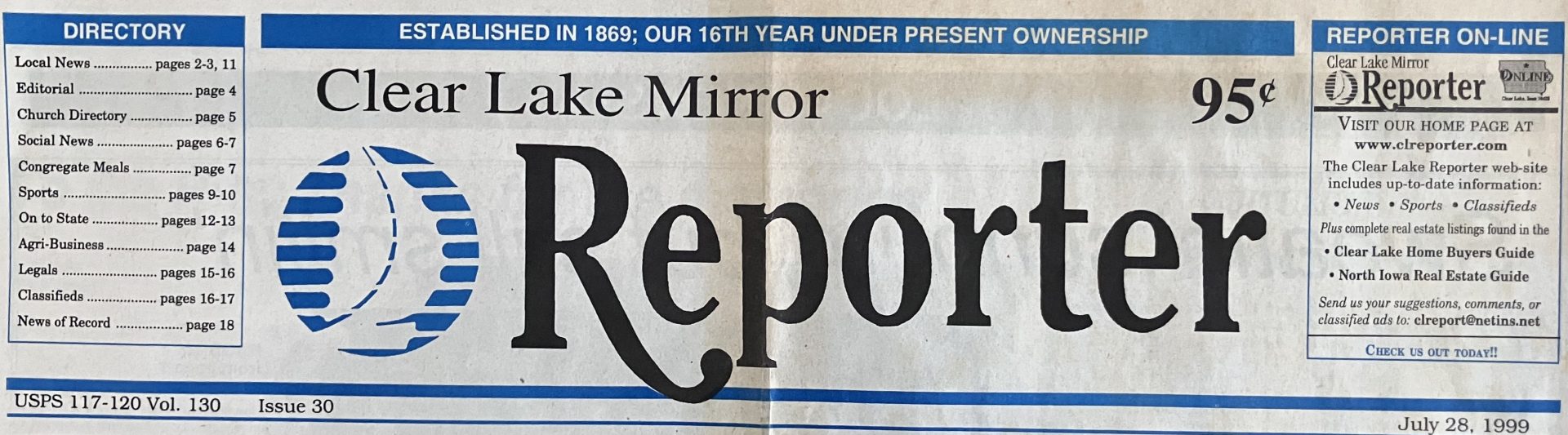
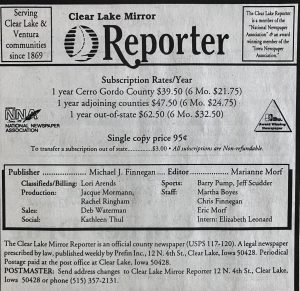 In 1983, ownership of the Mirror-Reporter returned, for a time, to Clear Lake hands. Local residents Mike Finnegan and Dave Parker purchased the paper from Mid-America Publishing, marking a return to community-rooted stewardship after two decades of outside ownership. Under their leadership, the Mirror-Reporter reestablished close ties with the town. Finnegan in particular became a prominent community leader, eventually serving as president of the Clear Lake Chamber of Commerce. For 35 years, the two partners guided the paper through the late 20th century and into the digital age, ensuring that the Mirror-Reporter remained a central institution in Clear Lake.
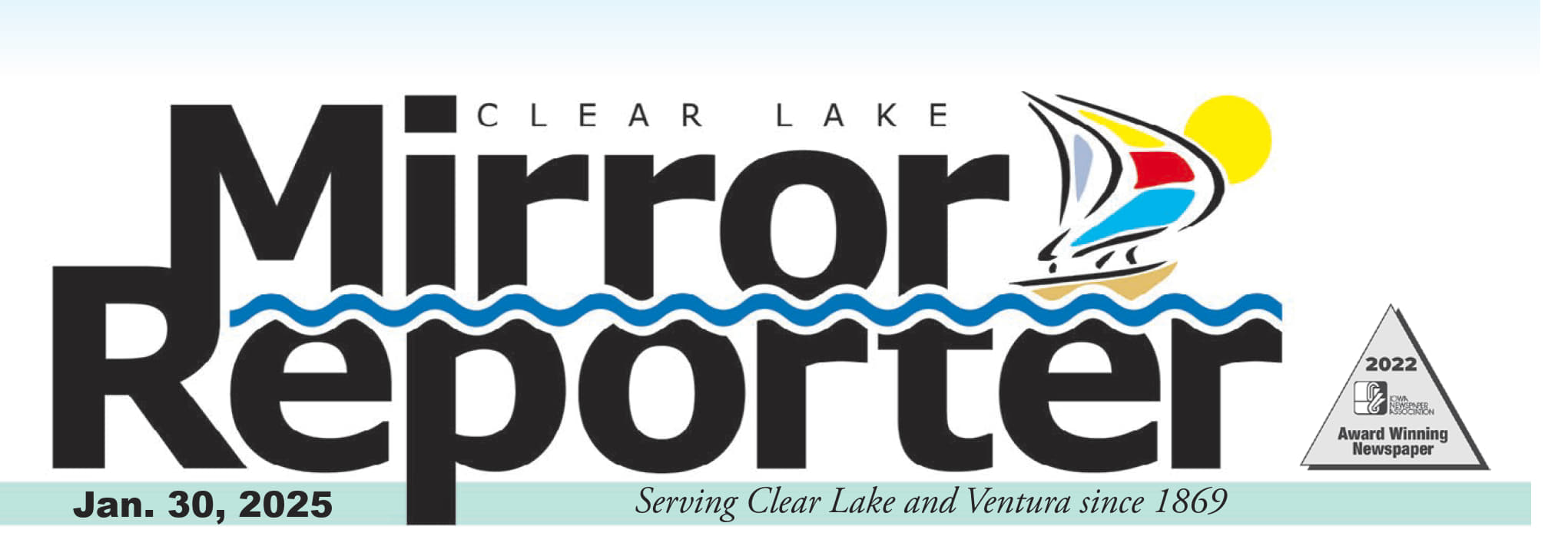
After this long period of local ownership, the cycle came full circle. In 2018, 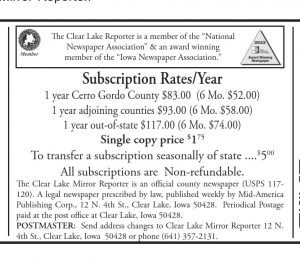 the paper was once again purchased by Mid-America Publishing, which by then had grown into one of Iowa’s largest small-town publishing companies with ownership of more than 30 local newspapers. This return placed the Mirror-Reporter within a regional network once again, but its identity as Clear Lake’s hometown paper—shaped by over a century of history—remained intact.
Enterprise Medal a Charles City-based publishing company founded by Christopher and Kristen Hall, purchased the Clear Lake Mirror-Reporter and the Garner Leader effective April 2, 2026. The newspapers were sold by Matt Grohe of Mid-America Publishing.