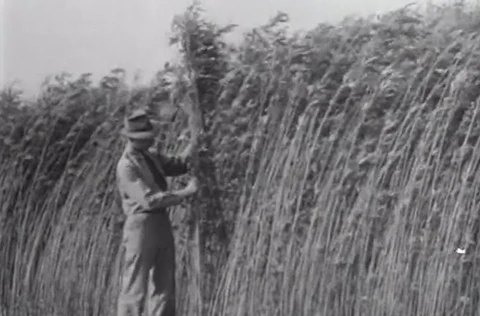
This week we are going to investigate the growing of hemp around Clear Lake. I’ll first share a quick memory from my teaching days at Clear Lake High School when I mentioned that hemp was grown and processed around Clear Lake for its use during WW II. One of my students said out loud, “That’s why ditch weed smokes so awful and smells so bad!” Needless to say, his classmates erupted into raucous laughter. I simply replied to him, “I didn’t hear you say that did I?” “Oh, no Mrs. S. it was just a comment.” Snickers continued for a short time, and we were able to settle into the hemp farming around Clear Lake during WW II.
 Yes, hemp was an important crop around Clear Lake during WW II. In 1942 and 1943, the U.S. Department of Agriculture urged the farmers of the Midwest to grow hemp on some of their acres of land for the war effort – “Hemp for Victory!”. The reason for the request was that the Japanese had blockaded the U.S. sources of needed Manila fiber from the Philippines and the sisal from the Dutch East Indies. These fibers were necessary for making rope. Rope was crucial to the war. North Iowa soil was ideal for the hemp crop, and our weather was considered perfect. The federal government provided farmers with the required federal permits allowing them to grow the hemp. The federal government also provided the seed needed based on acres planted and specialized machinery since implements used to harvest corn would not handle the very tough 10 foot hemp stalks that were being harvested. Sadly, many of the provided machines couldn’t handle the tough stocks either and much of the hemp was harvested by hand. Many extra workers were needed and Mr. T.G. Burns, the superintendent of the Clear Lake Community School District at the time, allowed high school students to be excused from school to help with harvest – was considered a patriotic service project.
Eleven of the forty Iowa hemp processing mills were located in north Iowa. The closest to Clear Lake was situated at a place known as Emery Junction. This crossroad is located at the intersection of B-35 and the Burchinal blacktop (S-34). This was a junction for the Iowa Traction Railroad which would be able to transport the baled help fibers to larger junctions for further distribution. When driving east on B-35 one will notice the buildings on the southeast corner of the intersection. Many of these buildings are the remainders of the Emery Junction plant. Buildings were constructed for storage, drying, milling, a mechanical shop, office and a special building to house the three 200 horsepower boilers used for heat and to dry the harvested hemp. The plant employed about 100 workers with one-third of those required to be women since this was a war project.
The hemp was harvested, bundled and allowed to “ret” which means rot. This process took about 3 weeks. There was a 4j0-acre parcel of land where “ricks” were constructed to assist with the retting process. Ricks were large wooden racks used to help with retting by allowing more air to reach the stalks. Each farmer was paid by the ton of hemp harvested. The rate allowed by the federal government was $40.00 per ton. The growing of hemp was anything but profitable for area farmers, but it was crucial for the war effort and Clear Lake farmers were willing to help. When the plant was finally closed at the end of the war, the remaining stacks of hemp were left outside of the buildings to rot. As a result, the seeds were allowed to blow into the ditches of north Iowa, land and grow into our still present (but less common today) ditch weed.
WW 2 Hemp Poster