Carp are not native to North America. In fact, they have a long history in Europe and Asia, as described in the “History of Carp (Cyprinus Carpio) in North America” posted on the America Carp Society website (https://americancarpsociety.com/us-carp-history). Carp were first imported to the US in the 1860’s from Europe and Asia, where they were considered a delicacy. In the 1880’s the US Commission of Fish and Fisheries studied carp as a supplement for the declining quantities of native bass, pike and pan fish that were declining due to overfishing and habitat destruction. The carp introduced to the US waters flourished in the muddy, cloudy and degraded waters. However, by 1900, the exploding carp population was blamed for the continued decline of native fish and efforts began to remove the carp.
Clear Lake newspaper articles in the early 1900’s reported on statewide efforts to remove carp from lakes and rivers. A successful seining program in Spirit Lake, supported by the State, was suggested as a solution for Clear Lake’s growing carp population. The carp population was concentrated in the weedy west end of the lake, Henry Kastner begin harvesting carp in 1906, selling it at his boat house in Ventura.
By 1910, the State Game Warden set a $400 annual fee to seine carp. While some carp were sold locally, the majority were kept in pens until a sufficient quantity could be boxed in ice and shipped by rail car to the east coast markets. The Clear Lake Commercial Club recognized the need to maintain Clear Lake’s sport fishing by reducing the carp population and also recognized the potential income from licenses and fees for large scale carp harvests. In 1913, the state arranged for Mr. Dixson from Peoria, Illinois to bring an experienced crew to Clear Lake to implement a large scale harvest of carp. Over 35,000 pounds were removed.
SJ Clausen and John Peterson obtained exclusive seine permits on behalf of the Commercial Club, with the provision that a local assistant game warden oversee the operation and any fees received be invested in lake improvements. The Club worked with an enterprising fisherman, Zeaman Magoon, who built holding pens and sold his catch though Charlie Ritz’s Yellow Front Shooting Gallery at the foot of Main Street, for six to eight cents per pound. In 1917, Zeaman opened his Magoon Fish company in the old Stevens Boat House at the foot of Main with Frank Vernon and Charlie Ritz as partners.
Magoon Fish expanded their operations acquiring a one-mile long seine net and installing a system of winches and cables to pull the ends of the net together to capture more carp. New rail cars were designed with large water tanks holding 30-40,000 pounds of carp that could be delivered live to the east coast markets. By 1923, Magoon Fish Company reported a one day harvest of 30,000 pounds of carp, increasing to a one day harvest of 80,000 pounds in 1925.
Zeaman became the face of Clear Lake’s carp removal program. During the 1923 season, his crew reported a thirty day harvest of 225,000 pounds of carp. In honor of his work to improve game fishing, the Isaak Walton League honored him as the “American Carp King”. His exploits were amplified nationwide as the Associated Press circulated an interview with Zeaman in August 1923.
The carp harvesting program was successful. The reduced carp population allowed the game fish to recover and the fees from the carp seining provided initial funds for a new fish hatchery. The lake could be stocked from the new hatchery, eliminating annual truckloads of fish from other Iowa lakes.
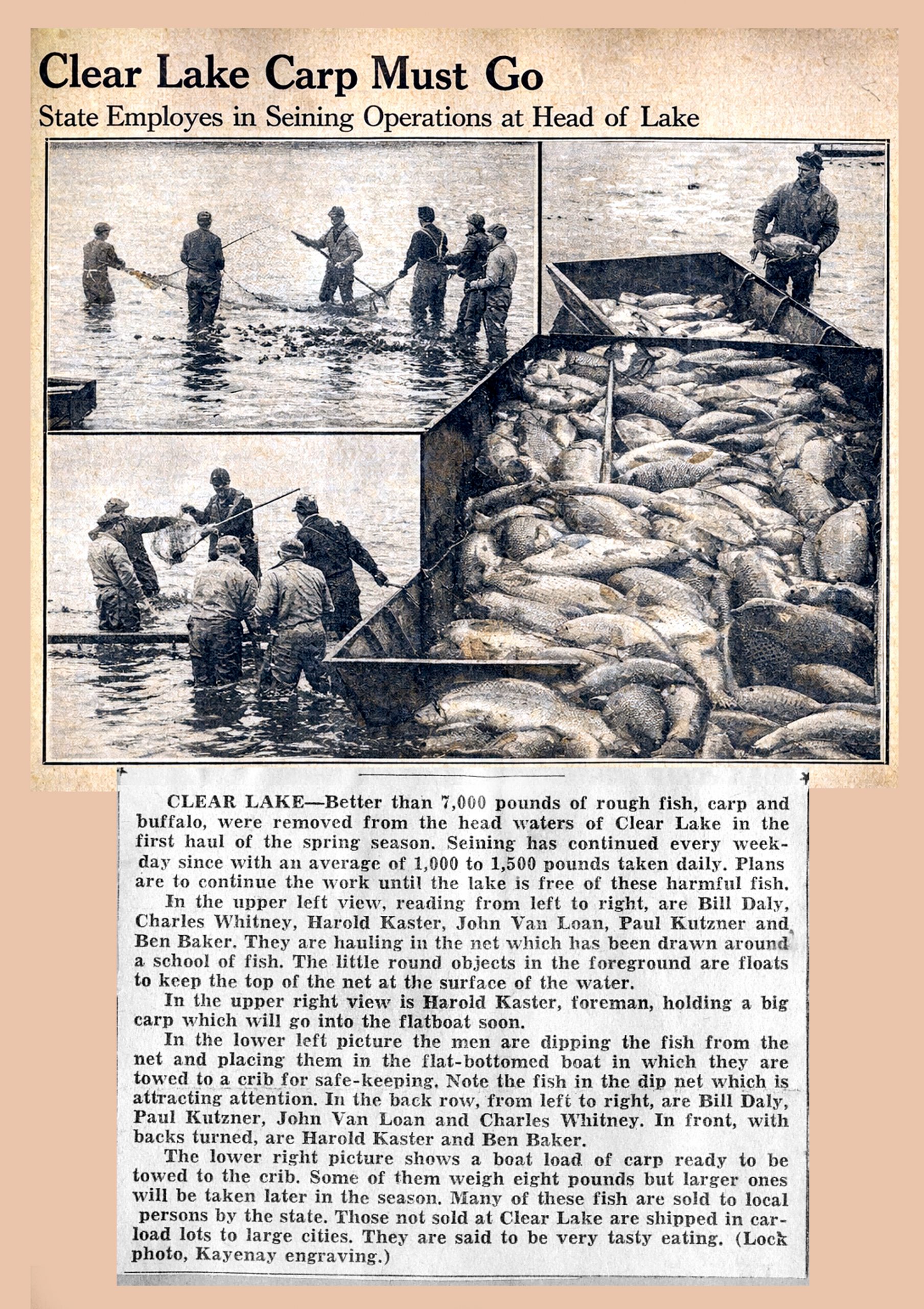
There are continuing efforts to balance the carp and game fish population. A 1937 article described the Clear Lake fishermen seining carp seining. The efforts of the CLEAR Project to improve fish habitat and water quality including dredging the west end of the lake and managing flow between Ventura Marsh and the main lake continue to improve Clear Lake’s game fish population.