
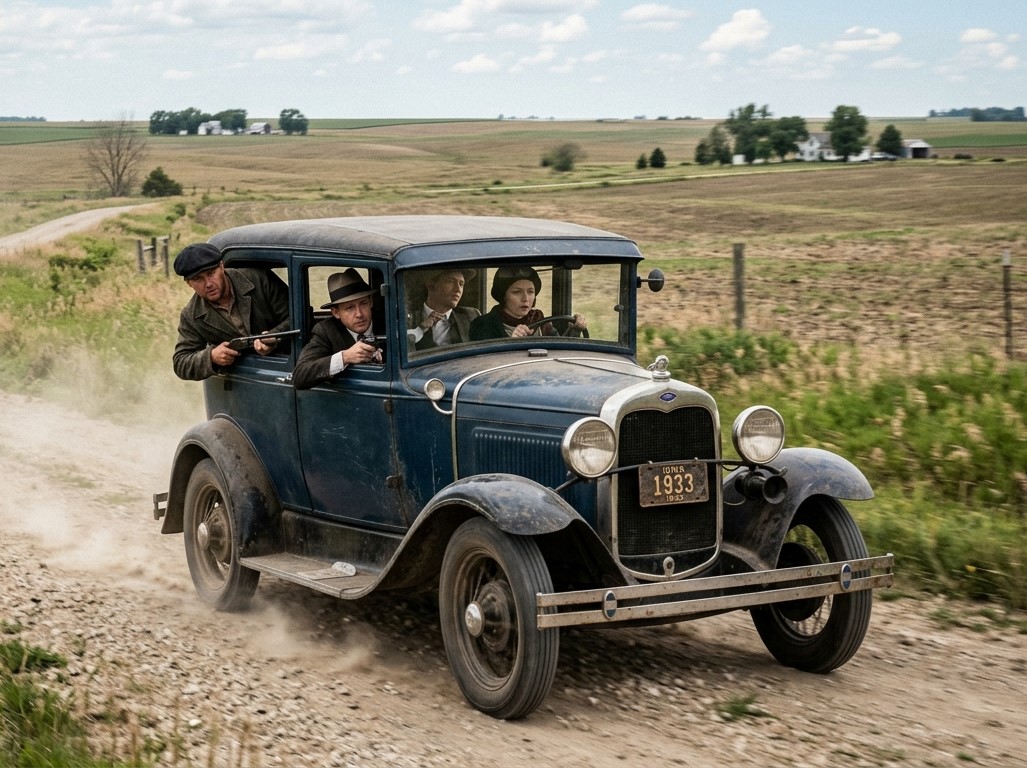
The Life and Times of the Burzette Family
The Burzette Family of Clear Lake fielded a group of men that left a trail of crimes that fascinated the county in the 1920’s and 1930’s. This article relates the story of the Burzettes, most notably Donald “Red” Burzette and his gang. The Chapters are:
Chapter 1– Crime, Murder, and Innocents Caught in the Crossfire
Chapter 2– The Heyday of Red and Mae Burzette
Chapter 3– Life Without Red was Still Colorful
Chapter 4– And the Band Played On
Chapter 5– We’ve Got Trouble Right Here in River City
Chapter 6– It Runs in the Family
Chapter 7– Fade to Black
Chapter 1 - Crime, Murder, and Innocents Caught in the Crossfire
Red Burzette wasn’t born a criminal.
Donald Anthony Burzette was born to Bela and Amanda Burzette of Clear Lake Iowa in 1894. He was their second son. Two daughters and another son followed to complete their family of 5 children. Every single Burzette kid met a tragic fate. We will follow those stories to their sad endings.
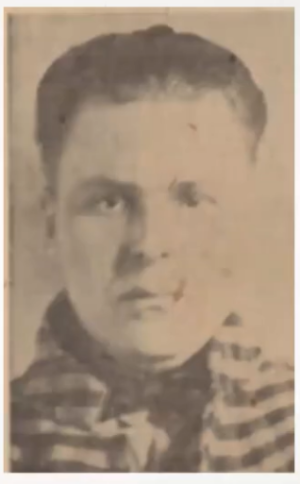 Because of his mop of bright hair, Donald was quickly nick named Red. Later he was known by law enforcement across the Midwest as Torchy.
Red showed great promise as a youth. His teachers reported that he learned his subjects easily and had impressive leadership qualities. Lead he did but certainly not in the way they had imagined. His Burzette Gang became the most hunted gangsters of the early 1900’s Midwest.
Young Donald was industrious. The Clear Lake Reporter published his name several times, documenting handsome sums paid to him for shoveling snow. Compared to the amounts others earned, his $4.50 was evidence he spent many hours on the business end of a shovel. Guns would soon replace shovels in Red’s ambitious hands.
Red and his friends had typical small town lives. They roamed about doing the usual teenage shenanigans. But as he became more sophisticated in planning and executing pranks, Red continually upped the anti. Pranks led to petty theft, theft to grand larceny and time spent in jails. Mobsters and murder were the norm for Torchy in his adult years.
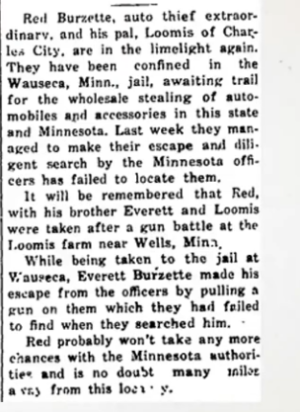 The earliest known trouble began in 1908 when Red and his buddy GW Cordt made their way to Albert Lea Minnesota. They broke in and attempted to steal furs from a store. Police nabbed them in the act. Red was sent to Eldora Iowa to the reform/ correction facility for underage boys. The reform was not successful.
In 1912 Clear Lake the train ran in the general area of our present day Charlie Brown Childcare. Trains were left for long periods unattended. That was an open invitation for Red and Charles Butterfield. They stole hides from a train car and quickly sold them to a buyer for pennies on the dollar. The buyer knew something didn’t add up right and alerted the law. The police immediately began looking for Torchy Burzette. Once caught and questioned, Red admitted to the theft. Charles served 6 months in jail. Red lied about his age and was once again sent to Eldora. He walked away rather quickly. No one bothered to return him.
While Red was being sent to Eldora, his Dad was standing in a courtroom pleading guilty to selling bootleg liquor. Not for the first or last time.
These were the years when tiny Carrie Nation smashed up bars wielding her large axe. Many of the speakers at our Chautauqua, including Carrie, preached the evils of alcohol (though some still privately imbibed). Each state imposed its own temperance laws. Bootlegging was illegal even before Prohibition was the law of the land.
The environment was ripe for exploitation. Organized Crime saw a flourishing market opportunity. Booze runners, essential to the business, set the scene for better roads and faster more reliable cars. This was the birth of NASCAR. The winning driver of the first race had honed his skills by eluding the police while running his booze.
People are funny. Tell them what they can’t have and they want it more. Prohibition proved that the thirst for booze was unquenchable. The Mafia became wealthy as they supplied the pipeline of speakeasy’s and blind pigs. Red took notes.
An auto theft in 1916 earned Red another stint in jail. A Clear Lake fisherman reeled in an unexpected catch off White Pier. It was a license plate from a Minnesota car. He turned it over to the police and the question was asked- Where is Torchy?
The plates were matched with an auto that Torchy admitted he and his pal Loomis had stolen, stripped and fenced. They were both locked behind bars in Waseca Minnesota. Bars couldn’t contain the clever bandits. They escaped in a stolen car and moved their thriving illegal business to Sioux City Iowa. Despite being chased by numerous officers they managed to remain free and continue their spree. Their crimes got more profitable and dangerous.
In all these years of living on the edge, Red still found time to fall in love. 16 year old Donald Burzette made 15 year old and pregnant Grace Gilbert his bride in 1910.
Mildred Burzette was soon born but struggled to thrive. She passed as a small child and is buried in our Clear Lake Cemetery. Another daughter, Ethelyn, arrived shortly after Mildred’s passing.
While these daily events of family life unfolded, Red was masterminding his gang and delving deeper into the underbelly of society. His constant convictions and absences took a toll and Grace filed for divorce in 1914. It’s doubtful he ever saw Ethelyn again.
Red didn’t seem to miss a beat romantically. He met and fell instantly under the spell of Mary “Mae” Josephine Yetzer. She was stunningly beautiful. The press crowned her The Queen of the Bandits. Together Red and Mae were as infamous as Bonnie and Clyde became two decades later.
Life was exciting for the high spirited couple. Until a murder turned the notorious duo into the most wanted fugitives of the Midwest. Their story dominated headlines and captivated the nation.
Chapter 2- The Heyday of Red and Mae Burzette
“A Parasite on Mankind”
Red’s roots were from a poor, struggling family in Clear Lake Iowa. Mae was raised in a privileged upper middle class home in Minnestria, Minnesota. It’s doubtful that as kids they either one dreamed of becoming a criminal when they grew up. But they came together like peanut butter and jelly and embraced the gangster lifestyle.
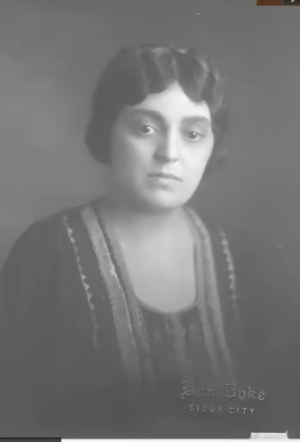 Red provided Mae with adrenaline filled thrills and the romance of life in the fast lane. Mae was arm candy on Red’s side and was said to be the brains behind the gang. They ruled the underground scene in the Midwest from 1915-1919.
Law enforcement estimated that Red’s gang was responsible for 5-6 murders under Torchy’s direction. They were constantly one mistake away from being captured to face the consequences of their nefarious actions. Mae wore stylish clothes and furs and was draped in lavish jewelry. Did stolen money buy her the bling or did they simply steal what she wanted? Red’s reputation opened the doors to high rolling gambling tables. Liquor flowed freely, the music was nonstop and brawls broke out regularly.
Outlaws live in the shadows. Details of their lives are sketchy. They didn’t exactly sit down with reporters and certainly not the law. But some things are known.
Along for the wild ride were several loyal gang members. Stoic Ira Pavey would unquestionably follow Red – even to the gallows. Tex Maynard, Elmer McClain (Murray), Wilbur Siglin, and William Convey all hung their hats with Torchy. Jim Davis was often right next to Red. Everett Burzette, Red’s older brother and cousin Melvin Burzette were on and off members of the group. They soaked up all the tips of the trade they could learn.
The one crime that is well documented ended up leading to the brutal end of Red Burzette.
It happened on an early spring day in Iowa and Minnesota. Red, Mae, and Ira set off from Sioux City Iowa to Troski Minnesota to procure bootleg liquor they planned to resell.
In 1919 the roads were more like suggestions of paths. No gravel or blacktop improved the deep, narrow ruts of the frost heaved muddy ground. Cars bounced around like children’s toys. Sturdy tow ropes and hip high wader boots were standard equipment.
Red and Mae lurched through the mud ruts in a 7 passenger Buick. Ira followed in his Dodge Roadster.
They ran into a road block when they got to Perkins Corner. A farmer was helping to pull another car out of the road. Several other bootleggers were on the same popular route. They exchange greetings as they all waited to get back on the road. Red learned that Claude Lether had already been to Troski and was on the way to South Dakota to sell his load. 11 cases of whisky.
The lure of easy money was too much for the gangsters. And in addition the thought of continuing to battle on to Troski wasn’t attractive at all. They decided to leave Mae in the Buick and leave to steal Claude’s whisky. He drove on after the road was cleared. They waited until everyone else had left, then took chase after the bootleg. But chase is not a good description of what happened. Keystone cops might be a better idea of what occurred. The robbers set off at about the same speed as a horse’s trot. As they gained on Claude, they began shooting. Cars didn’t have window glass on the sides. The bullets easily penetrated the flimsy window curtains. Claude was shot dead.
Red and Ira dumped his body in a muddy field. They took $500 dollars off Claude’s body, approximately $9,000 dollars in today’s money. And of course the 11 cases of whisky. A very profitable day indeed.
They backtracked to collect Mae. The merry band of 3 then continued on to Wessingten South Dakota over the painstakingly slow roads. It took them almost 24 hours to reach their destination. Today that distance takes less than 3 hours on smooth roads in cars with window glass.
Towards he end of that marathon journey, Ira’s car was sucked into a ditch. They left the car and Ira squeezed in with the Burzettes. At Wessingten they finally fell into bed in a rooming house and slept.
The next day Red and Ira hired farmer Pete Aartman to pull Ira’s car out of the ditch. Pete received a full bottle of whiskey and some cash as payment. That soon to be emptied whiskey bottle became a very important piece of evidence.
Now to sell the whiskey. Ed Graves bought the whiskey for the enormous sum of $5,000 dollars. He was traveling with a widow named Mrs. Lewis. She and Mae struck up a conversation while the men did business. Mae showed her their car.
Mrs. Lewis noticed blood all through the car. The whiskey cases were splashed with blood. Later she read the newspaper and learned that Claude had been shot. She put the pieces together and was happily yapping to others about what she’d seen. Ira got wind of her gossiping ways and returned to Ed. He told him to “Shut that woman up!” He explained the blood was because they’d butchered a chicken. People were closer to the food chain back then, but butchering in the car was a bit far fetched. The story didn’t satisfy either Mrs. Lewis or Ed Graves.
Still free range bandits, Mae and Red and Ira returned to Sioux City. The hard driven car needed a new tire. Tex and Jim took it to the carbarn shop for repairs. They didn’t bother to pay, just made sure the attendant saw their guns. The carbarn had a restaurant attached. Jim and Tex met Red there for breakfast.
The attendant was the son of a local policeman. As soon as they left, he ran to the police station and alerted the law.
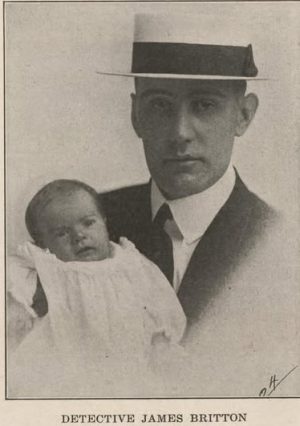 Detective Britton was out the door and ready for an arrest. He walked in the restaurant and saw the most wanted fugitives eating, with their left hands. A chaotic confrontation was on! The right hands of the criminals came from under the tables with guns blazing. Britton fired several shots. At the end of the 10 second flurry of bullets, the smoke cleared. Red lay on the floor among the shattered plates and smeared eggs. Tex Maynard lay beside him, wounded. Jim Davis was still seated but critically wounded. Detective Britton was mortally wounded but still alive. He would die later in the hospital, his wife by his side.
Britton had killed Torchy Burzette, the man law enforcement called “A parasite on mankind.”
Jim and Tex were imprisoned. Ira was being sought for murder. Red was dead. The gang who had controlled the streets was no more.
Or was it?
Chapter 3- Life Without Red was Still Colorful
Red Burzette came back to his hometown Clear Lake one last time. His Dad traveled to Sioux City to collect his dead boy and common law wife Mae for a private funeral.
A small ceremony of family and close friends was held in the Burzette home. Red is buried in the Clear Lake cemetery under his birth name Donald Burzette.
1894-1919. Red was gunned down at 25.
Mae was devastated but no so devastated as to demand the cash she believed her husband was carrying at the time of his death. She was even so bold as to file papers in court saying she was the rightful owner of said cash. Only a couple bucks were found on Torchy’s body according to Sioux City police. Tex Maynard was holding two large rolls of cash. One was $1,100 dollars and the other was $450 dollars. Tex was probably holding Red’s money but Mae would receive $0. This isn’t the last we’ll hear from Mae.
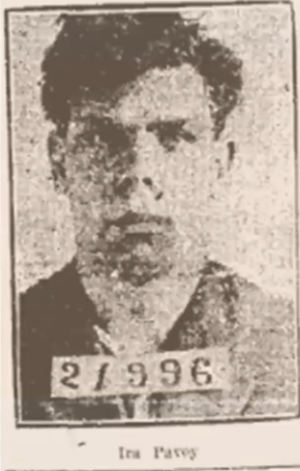 The manhunt for Ira Pavey was on. A grand jury had indicted Red, Ira and Mae. Police searched high and low for Ira. He was finally discovered in a most unusual place. Prison. He was serving out a sentence in prison in Missouri. After he complete that sentence, Ira was returned to Iowa to face even more serious charges. Murder.
Because he’d previously escaped from Fort Leavenworth by jumping off a 40 foot wall, he was closely guarded. Pavey, born in 1892 in Kansas City, had spent lots of time as a youth in a reform school for boys. Just like his pal Red, he was not reformed.
His capture and subsequent trial became the show of the century. Newspaper boys shouted the shocking headlines from corners, hyping the already charged atmosphere. People came early to line up on the Orange City courthouse steps, eager to get a seat in the courtroom. They all hoped to get a glimpse of the murderer and the Queen of the Bandits. Those who got in were not disappointed. The trial was quite a spectacle.
Once Red was gone, Mae’s loyalty to the gang took second fiddle to her survival instincts. She quickly betrayed Ira. She exchanged her version of the events surrounding Letner’s murder for her freedom. The police who escorted the beautifully dressed woman were smitten by her impeccable manners and serene demeanor. She had the bearing of a queen.
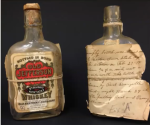 In addition to Mae’s damning testimony, farmer Aartman entered his now empty whiskey bottle as evidence Red had paid for his services. That bottle was connected to Ed Graves. A short line connected the dots to Mrs. Lewis. Chatty Mrs. Lewis got to tell her story of a bloody car interior to a larger audience this time. They must have been on the edge of their seats and she must have been in heaven.
Ira sat silently and still through the 4 days of the trial. Even when the murdered man’s wife fainted in court, he was impassive. He didn’t flinch when after 2 hours of deliberations the jury delivered a guilty verdict. They recommended the death penalty and the judge immediately complied.
Hard Boiled Pavey was stoic until the end. His story was finished in September of 1922. His mom and sister were allowed two hours with him before the execution. He sent them home before the final curtain was drawn because he didn’t want them to suffer. Perhaps there was a human in that body after all. His last meal was fried chicken and ice cream.
Ira calmly walked to the gallows with his usual guard, smoking along the way. The guard told reporters afterwards that he’d said something to Ira like This Stinks. Ira was said to reply Yes but it’s Fair. He had a smile on his face as the hood was placed on his head and the lever pulled to hang him by the noose. His execution ended a 12 year streak of no death penalties carried out to the inevitable conclusion in the state of Iowa. His mom took his body back to Kansas City for burial.
One more Burzette gangster was gone for good.
Mae Burzette persisted. She walked away from Ira’s trial a free woman and returned to Sioux City. She kept her affections in the family. She and Claude Tex Maynard were married in 1921. Together they ran a boarding house that built a well deserved seedy reputation.
Police were called to the address regularly. In 1923 Mae was arrested for keeping a disorderly house and various liquor violations. In 1925 a murder happened in her boardinghouse. She and Tex were held in jail, suspected of being involved, but eventually they were released. Rumors flew that the couple was responsible for the murder of a WW1 vet. They also were thought to be the people behind stealing money and jewelry from an elderly rich woman.
Tex died of a heart attack in 1939. Mae married again in 1942. Frank Freeman was 58 and she was 47. Mae died Mrs. Freeman in 1969 on the 4th of July. She lived 74 turbulent adventuresome criminal years.
In their lifetimes, gangsters spent time in cemeteries. They frequently stashed their bootleg supply in the hollow gravestones.
In death, Mae is buried at Logan Park Cemetery in Sioux City Iowa.
Chapter 4- And the Band Played On
Tex Maynard got lucky. Kind of. It was determined in the shootout at the car barn that killed Torchy and Detective Britton that Tex had not fired his gun. That “honor” was given to Jim Davis. Jim was charged with the murder of the detective.
But Tex wasn’t home free. He was found guilty of the charges of larceny and sentenced to two terms of 5 years each. He was released in October of 1924 having spent 5 years total for his offenses.
He went home to be with Mae. Together they were suspects in numerous thefts and at least one murder in 1925.
By June of 1925 Tex had joined up with his Burzette gang buddy Jim Davis and newcomer, Elmer Welch. The three of them were accused of shooting the motorcycle riding traffic cops George Howland and Ferdinand Alexander. The officers tried to stop them on traffic violations, not realizing they were thwarting a bank heist in the process.
Davis is thought to have fled to Canada but Tex was heading right back to jail. This time he served in South Dakota. Just a handful of days following his release from that jail in 1939, he was right back in custody. This time for failure to register as felons were ordered to do in Sioux City. He was told that if he’d serve 15 days out of the 30 he was ordered to, he’d be released. There was a catch. He had to promise he’d leave Sioux City for good.
It’s not known whether he honored that promise, but we do know he left Mae a widow in 1939. His luck ran out. His heart had enough for one lifetime.
He was described as frail in the article detailing his latest brush with the law. That same article seemed to pay homage to the elderly gangster. He and the Burzette gang’s crimes were said to leave Jessie James’ spree in the dust.
Jim Davis. Wanted Dead or Alive. It took years to get to this point for Jim. In the Sioux City papers he’s called the number one fugitive from justice. He’s getting used to it – reported the Journal. The charges he faced this time were grand larceny. Jim sold a car that was stolen. By him. He also had numerous bootlegging fines pending.
His most serious crime was murder. In the dramatic shootout in the carbarn with Red, Jim’s gun fired the shot that killed the deputy. Newspapers described him as being 27 years old, 5’5” tall and 200 pounds. He had a dark, swarthy complexion. In addition to his distinctive naked lady tattoo below his elbow, he now had 5 bullet holes in his body.
His first trial for murder was shocking news. Surprisingly the jury didn’t deliver a guilty verdict. His second jury trial in a different county did. He was sentenced to life in prison for the shots that killed Detective Britton.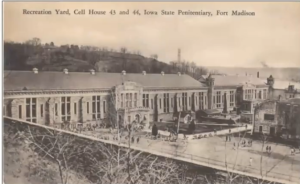
When he was healed enough to be moved from the hospital to Fort Madison, the deputy sheriff transferring him put in a good word. James Jackson told the guards at the prison that Jim would be a good prisoner. We can now laugh at that optimism.
Jim attempted to escape the first time while refereeing a baseball game. The excitement of the game provided cover for him to scale the prison wall. He’d only gotten a couple feet away when a guard winged him in the leg. Hole number 6 in his body.
The second attempt was successful. Jim hid in a load of coal cinders leaving the prison. These loads were routinely jabbed with long very sharp rods, but he somehow managed to avoid injury.
He fled to Canada where he became Jim O’Brien, the barber. He learned barber skills in the joint. His first wife had divorced him so he was free to remarry. The new couple had a son. Jim lived a fairly quiet life for 8 years. Then a gambling table in 1929 put him in the spotlight of the law again.
He accepted a watch as temporary payment on a debit owed to him. The man who owed him the money produced the $20 and expected his watch back. O Brien couldn’t give the watch back. The man filed theft charges against Jim. A shocking discovery! Davis was fingerprinted and found out. He was returned to Iowa to face the music.
He served his term. This time he actually was a model prisoner. He won a pardon and traveled to the West coast. But the call of Sioux City once more brought him home in 1945. After spending about a week in the hospital, Jim Davis passed in December of 1945. He was 55. He is interred in the Rutledge Mortuary.
Elmer McClain alias Elmer Murray played a 7 year game of cat and mouse. He was winning until he was found in Chicago in 1926.
He had been charged at the same time as the rest of the Burzette gang. His offenses were auto theft. Once captured all these years later, his sister Evelyn Snyder posted bond of $6,000 to keep him free. But inevitably the courts sent him to Anamosa to serve 40 years.
Friends and family began to petition the court immediately for parole. After 6 years, he was awarded parole. He returned to Sioux City but his name isn’t part of the public records from then on.
William Convey was given a life term for killing a sheriff in a separate incident. He and several accomplices were sent behind bars. He did escape but was returned quickly. We know little about him from then on.
Wilbur Siglin was one of William’s accomplices in the murder. The killers locked up the sheriff’s wife and two daughters, ultimately leading to daughter Fern Maxwell’s death. Wilbur was the only convicted murderer who didn’t try to break out of that jail. He was sent to Amamosa.
His wife Mildred filed for divorce in 1928. Her grounds were cruelty. She filed again in 1929 for nonsupport of the couple’s minor children. He was free at that point but his freedom was tied to the future support of his children. He wasn’t found in the court records again so maybe he straightened up and flew right?
The name Burzette was absent from the newspapers for a time. Until it blazed back in new sensational headlines. Newspaper boys on corners once again shouted out the scandals, selling more papers.
Chapter 5- We've Got Trouble Right Here in River City
Everett Burzette didn’t have the devilish good looks and easy charm of his younger brother Red. But he was handsome enough. As a large man he had a commanding physical presence.
He listed his occupation as an ice cutter. However he did share one thing with Red- the life of an outlaw. They were active members of the Burzette Gang. In that occupation they did have “success”. How successful we are left to wonder. We know of the crimes they faced justice for but it’s impossible to know how many went undetected and unpunished.
The first evidence of Everett breaking the law is documented in 1913. He paid a hefty 1913 fine of $100 for selling bootleg liquor. In July 1916 he was jailed in Clear Lake for auto theft but promptly escaped. It was a year later in 1917 that he was apprehended and put behind bars in Mason City.
Soon after his release from serving that time, Everett stole a Buick in May of 1918. He managed to eluded the law until 1919. He was rounded up in the same raid that landed Red and his pal Loomis in confinement in Waseca Minnesota. Everett pulled off an escape before the ride to jail by brandishing a knife the police had missed when frisking him. Red went to jail. Everette remained free. Until he was discovered in another stolen car later that year. He was sentenced to 5 years in Fort Madison that began in October 1919.
That mistake cost Everett 5 years. In 1923 he was released early for good behavior. But he quickly returned. The next stint he served was a little over a year for leaving the scene of an accident. He ran down a Mason City woman with a stolen car and left her lying wounded and broken in the street.
In 1925 Everett was once more back home in Clear Lake. He and his cousin Melvin Burzette , 20 years his junior, rented a shack together. It was on the then outskirts of town. Around the 4th Avenue area of town today.
Their house was well known for rowdy all night parties. Everett had met a pretty lady, Joy Young. We know she had a baby and timing would suggest Everett might be the father.
Everett and Melvin decided to do some home improvements to the run down shack. What better way to decorate than to steal what they wanted?
They chose to go shopping at school house #4, Lime Creek school, a few miles northwest of Mason City. On a cold dark night, Everett and Melvin broke in the schoolhouse and started collecting the home furnishings that would make their shack a home. They had the blinds loaded and were carrying the wood stove worth around $5 out to the car when they were surprised by gunfire.
Morris VanNote, a prominent 51 year old farmer, was ready to protect his property. Morris was the head of the school board. The school had been the target of burglaries on several previous weekends. VanNote was loaded and prepared to engage. That engagement left him dead.
Neighbors thought they’d heard gunfire. Within a few hours of him being gone his family started searching.
They found his body in the school’s yard. They also found a hastily dropped shotgun, a wood stove and foot prints.
Everett and Melvin stashed the blinds in the shack and fled town. Their route wound through 9 states as they covered 2,000 miles in a desperate attempt to stay free. They saw Iowa, Minnesota, Illinois, Wisconsin, South Dakota, Wyoming, Nebraska, Kansas and Oklahoma. They traveled by stolen car, rode the rails, and walked many, many painful miles step by step. Melvin was soon exhausted by the constant adrenaline, eating little to nothing, and sleeping even less. Melvin later recalled the heavenly night spent on soft grass in a kind farmers barn.
In Oklahoma the police noticed their odd behavior. They drove the streets aimlessly while furtively looking over their shoulders. When they stopped the two, they found an arsenal of weapons in the stolen car. Fingerprints quickly linked Everett to Iowa. A call confirmed a warrant was out for the fleeing killers.
Once returned to Iowa, it took two juries to convict the cunning Everett. He wove a web of lies about his whereabouts on the night of the shooting that some jurors bought. He, his sweetheart Joy, and a bootleg delivery man all testified that he wasn’t near the scene. They swore he was home tending carefully to an ill Joy. They placed the blame squarely on cousin Melvin.
Everett’s power of persuasion was strong! Stronger than the testimony from the hardware clerk who’d sold the shotgun found on the yard to Everett. Stronger than the confirmation by teacher, Clara Wooldedge, that the blinds found in the Burzette shack actually belonged to the school #4. Melvin’s honest account of the night was put in doubt.
72 hours of deliberation produced a hung jury. $5,504 1926 taxpayer dollars led to nothing. Except another trial.
A second trial in November of 1926 would be different. And yet the same. The same in that lines formed outside the courthouse doors and newspaper headlines once again screamed Burzette.
This time Everett turned the blame on the dead man. He claimed he’d shot in self defense after Morris VanNote fired his gun first. It didn’t fool the jury. Guilty. Things were different in that Everett was condemned to a life of hard labor in Fort Madison prison. He started his sentence on December 23, 1926. Merry Christmas.
For many years, Everett was a model prisoner. He had worked his way up to trustee in 1947 when he once again escaped. The 59 year old mobster was only free briefly. He was captured in Ottumwa two days later and returned to Fort Madison.
He died in 1955. How and where aren’t clear. Perhaps he’d died in the place he spent most of his life, Fort Madison. His legacy might be best described by his own mother. She was interviewed by the law after he was returned from Oklahoma to face justice.
“I tried to bring him up right and honest. I did everything I could for him. If he wouldn’t mind the things I taught him as a boy, I couldn’t help it. If he did wrong, I don’t uphold him.”
Chapter 6- It Runs in The Family
If Melvin was already sorry for the terrible events of that crime, his life did not improve on the run. He tired very quickly of lack of sleep and unpredictable meals. His cousin constantly berated and bullied him. Because of the exhaustion and frustration, Melvin finally caved to the police under questioning. He told the truth about the robbery turned murder.
Everett did his upmost to hide the facts and insisted that Melvin and only Melvin was responsible for the crimes. He accused Melvin of trying to pin the blame on him. He produced witnesses to back up his story of him tenderly caring for Joy at home. It almost worked but in the end Everett would pay for his dirty deeds.
Melvin too would pay for his part in the death of VanNote. He was sent to Anamosa in May of 1927 after pleading guilty to 2nd degree homicide. In 1931, he was paroled on Halloween day after serving 4 years.
He wasn’t in the news again until 1937. He was sent away again after he helped himself to a pig that wasn’t his. He did three years in Anamosa for that hog roast.
By 1947, he was married and had 5 children. The judge next doled out 6 months in county jail for forging a $40 check from a former employer.
Another paper hanging spree in 1961 put him behind bars for one more year of his life. As soon as he was released, he was arrested for numerous check forgeries. Now 57 years old, he was held under $1,000 bond. It’s unclear what his penalty was for those offenses.
He paid his final fine in 1967. He passed at 62 years old. His funeral was held at Beckmann funeral home and he’s buried in Nora Springs.
The Burzette Gang was officially out of members.
Out of business.
Chapter 7- Fade to Black
The Burzette Gang has all the makings of a Hollywood blockbuster. Swashbuckling marauders, free flowing liquor, beautiful intelligent women, interesting supporting characters. Who would you choose to play the lead roles?
But wait. There are still roles to be cast. What happened to the rest of the family?
B.W. (Bela) Burzette admitted to selling bootleg liquor. But honestly that wasn’t uncommon in those days. He never lied about it, took responsibility. He farmed for years until he finally had enough money to buy his own team of horses and gear.
He was described as a hard worker who was quick to help out anyone in need regardless of their ability to pay. He was industrious and worked hard on the ice harvesting on Clear Lake for many years. He was still vibrant and working on the ice in 1929 when he suffered a debilitating stroke. Two weeks later he died with his wife and daughter by his side. He’s buried in Clear Lake’s cemetery.
Amanda Burzette came into the world with company and left the same. She was born a triplet. One sister passed as an infant but another, Martha Mc Kinney, lived with elderly Amanda in the county home.
During her prime years Amanda is mentioned many times along with her daughter Dorothy as contributing to civic clubs. They enjoyed doing good things for the local community.
In 1939 Amanda passed at 72. She’s buried next to her husband in our cemetery. Her life certainly held both great joy and unimaginable heartache.
B. W. And Amanda had a daughter they named Mina Clare in 1896. Sadly she passed as an infant.
Merle Clair Burzette followed in 1898. This third son of the couple didn’t follow his two older brothers’ footsteps. He did not commit crimes but in a sad twist passed from a tragic crime.
He left home as a young man and the family lost contact with him. In 1928 newspapers across the country carried a story put out by the American Legion about a murder in Texas. They described the victim and the Burzettes thought it sounded like their long lost son.
B. W. traveled to Mc Carmey and confirmed it was their Merle. Merle owned a store in the country. He’d been sitting inside after dark when he was shot through the window by Mr and Mrs Bill Brakke for the purpose of robbery.
Merle, mortally wounded, managed to put out the light and crawl to his car. He was able to drive to a gas station closer to town for help but died shortly after getting there.
B. W. stayed in Texas almost a month settling the affairs of his youngest son.
And now there is one. Dorothy Burzette is the remaining child of the couples 5 kids. She almost didn’t make it to adulthood. In 1927 when she was 18, she walked out on frozen Clear Lake to visit her dad while he was harvesting ice. She hit a soft spot and the ice collapsed. Dorothy plunged into the icy water. She struggled to cling to a side of the ice hole until several men came to her rescue. They used a lasso and pulled the girl to safety.
Dorothy moved to Mason City. She held a job as a waitress and bar maid. She was at work one day when she got a visit from a couple policemen. They informed her about her brother Everett’s escape from Fort Madison prison. Dorothy immediately crumbled to the floor. She’d suffered a stroke and passed a few hours later in the hospital.
A newspaper thank you indicates she was widely loved and highly respected. After a well attended funeral, she was buried next to her parents and brother Red in the Clear Lake Cemetery.
The Burzettes.
They lived in Clear Lake. They loved in Clear Lake. They terrorized Clear Lake.
They rest for eternity on the hill in Clear Lake Cemetery.