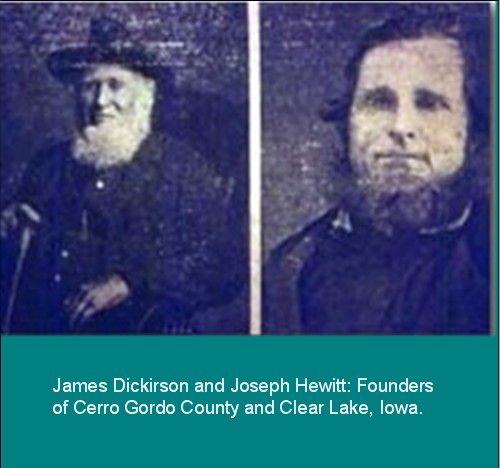
The James Dickirson and Joseph Hewitt families were Clear Lake’s first settlers
James Dickirson was born in Missouri on April 29, 1820. After being involved in lead mining near Galena, IL, he moved to Jackson County, IA, in 1834. Staying there only a short time, Dickirson and his family traveled to Clayton County where he met Joseph Hewitt.
Joseph Hewitt was born in June of 1794. Moving from the eastern United States, Captain Hewitt became well known for his abilities as an Indian trader. He spent a considerable amount of time at the Fort Crawford, WI, Indian Trading Post before coming to Iowa.
Once Dickirson and Hewitt and their families met, it was decided that they would move west to the area known today as Cerro Gordo County. Upon arriving at Clear Lake on July 14, 1851, the Dickirsons and Hewitts established their homes and eventually the community of Clear Lake.
Both Hewitt and Dickerson, along with Marcus Tuttle, platted the towns of Clear Lake City, Clear Lake Village and Lavonia on land they had entered. The present City of Clear Lake eventually emerged from the combination of the original plats and later additions
Both Dickirson and Hewitt became involved in more land and community development in western Iowa but both returned to Clear Lake in their later years and both died in Clear Lake. Joseph Hewitt died on May 6, 1865, and is buried in Section 1 Lot 59 of the Clear Lake Cemetery. James Dickirson died on June 16, 1908, and is buried in Section 1 Lot 42 of the Clear Lake Cemetery.
The Rest of the Story: Joseph Hewitt
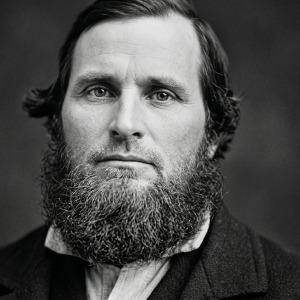 Legends grow over the years. Like the story of Daniel Boone, the story of Joseph Hewitt took some interesting twists. In 1916, the authors of the HISTORY OF CLAYTON COUNTY, IOWA, wrote, “In 1840 Mr. Hewitt removed to Clayton County . . . Hewitt’s reason for leaving Dubuque County was that he must push further so as not to be crowded and his desire to trade with the Indians. He is said to have had a number of wives. Mr. Hewitt maintained his residence . . . in Clayton County ‘til May 20, 1851, when with Dickirson, he removed for the West.
In that same volume, the writer exclaimed, “A little further on, we hear the rippling sound of Hewitt’s creek as it comes through the forest to swell the waters of the Volga. This stream received its name from Joseph Hewitt, who settled upon its headwaters in 1839 . . . Hewitt was born and raised upon the frontier of Missouri and was a hunter in the full and rounded acceptance of the word. We knew him early and well. Among the many hunters of the horde . . . he alone could have stood forth as a representative of Cooper’s ideal hero of the pioneers. He would often say with a dejected expression on his face: ‘The Country will soon be overrun with settlers and all game driven toward the West.’ As the settlements drew near to him, he listened for a time to the distant tinkling of the cowbell, and then, mournfully shouldering his rifle, turned toward the setting sun . . .”
However, Hewitt had hardly been born and raised upon the frontier, but rather was a native of West Virginia who moved with his family to Ohio. In THE HEWITTS OF ATHENS, CO. OHIO, Susan Mitchell wrote, “An enigmatic man of engaging charm, Joseph Hewitt embraced a materialistic lifestyle soon after his father’s death. His extravagant tastes and excessive demands upon the estate were apparently never questioned . . . more money was spent for Joseph’s needs and pleasures than for all of his eight brothers and sisters combined . . . Joseph received more schooling, clothing and ‘sundries’ than any of the others. In the book, she details, from the estate records, his purchases of expensive apparel, horses, livestock and livery between 1814 and 1822.
Mitchell continued, “The free-spending dandy, however, was only one side of a multi-faceted personality. First impressions to the contrary, Joseph Hewitt, a complex man with unconventional views, was a community leader and a true pioneer.” He was commissioned a Captain in the Ohio Militia in 1821 and served through 1827. He was instrumental in the organization of Waterloo Township and was elected constable and justice of the peace there. His 1827 personal property tax was the highest in the township. By 1830, he seemed financially secure and politically active, married in 1818 to Ruth Cranston, with whom he had six children.
But in that year, Hewitt abruptly disappeared from the county, leaving his wife and children behind. The intervening years are a mystery, but he finally appeared on the 1840 census of Dubuque County, Iowa, where he was living with a female “20-30 years of age.” Then the HISTORY OF KOSSUTH COUNTY, IOWA, stated, “Old Joe Hewitt . . . and his wife came into Iowa from Ohio about 1843 and settled at Strawberry Point where he traded with the Indians. His wife soon ran away with another man.”
According to Iowa records, Hewitt resided in several counties and earned a reputation as a trader, hunter and “natural-born frontiersman.” In the late 1850s, he was a mail carrier on a route from Algona to Forest City, by way of Buffalo Grove. It was written that this route was “across an open prairie where the storms fairly howled . . . during the winters.” Hewitt “could stand hardships that would kill a dozen ordinary men; for he had been used to a rough life all his days. In the fall he would set up poles with brush tops every three or four hundred yards . . . along his route to serve as guides when the air was filled with flying snow. He was then over sixty years old and was as hardy as an Indian.”
Known by the Winnebago Indians as “Nock-A-Shooka” (hew it), Hewitt was married at least twice more and fathered two more children before his death in 1865. His wife Elizabeth Hickman was 32 years younger than he and they divorced in 1857. His last wife, Harriet Morley, was 43 years his junior.
Hewitt died just short of 72 years of age at Clear Lake and is buried near the site of his original claim here. His obituary stated he “was not rich in worldly wealth, having expended it in hospitality and the support of others. His latchstring was always out.” Of such stuff are legends born!
The Rest of the Story: James Dickirson
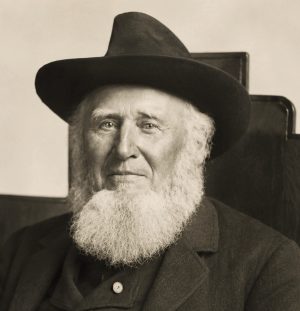 In the CLEAR LAKE MIRROR REPORTER’s 1951 Centennial Edition, James Dickirson was the subject of a feature. It stated “Uncle Jimmy, as he was so familiarly known,” was born in Orange County, Indiana, in 1820. . . The many things this kind man did for his community and fellow men would fill volumes.”
Dickerson was in Missouri, which other sources give as his place of birth “at age 23″ when “he met and married Ellen Schofield; five years later, he settled in Clayton County, Iowa, six miles from Elkader.” The article reported, “They had one boy, John, when Mrs. Dickirson died in 1840.” The dates don’t quite come together, for had he been born in 1820, he would have been 23 in 1843 when he was married; yet his wife reportedly died in 1840.
April 15, 1851, is given in the article as the year he was married again, just two months before he took his “famous journey to Clear Lake.” His marriage to Melissa Alaway was the first in Clayton County records. It was this wife and his son John who came with him to Cerro Gordo County.
THE HISTORY OF CLAYTON CO, IOWA, reported that the home of James Alaway, about a half mile northeast of Strawberry Point, was the site of the “first marriage in Cass Township” when Dickerson, “a widower who lived in Sperry Township” married Malissa on “May 12, 1850, with the Rev. N.W. Bixby officiating.” It stated, “The bride was the only marriageable woman in the township. A goodly number of relatives and friends were present. The table was split log with legs inserted and the rest of the household furniture corresponded with the table. The repast consisted of vegetables, chicken and pastries, the best the township afforded . . . Mr. Dickirson and his wife moved from the county in May, 1851.” Again, the dates are a little fuzzy.
During their first five years here, a daughter Malissa was born and then in about 1856, this second wife, too, died. June 7, 1861, he married Anna Williams, who “grew into old age with him.”
Dickerson became acquainted with Joseph Hewitt while both were living in Clayton County. According to Wheeler’s HISTORY OF CERRO GORDO COUNTY, they set out of May 20th in 1851 with their families and reached Clear Lake on July 14th. The distance was only 100 miles, but they traveled further due to the lack of roads and flooded streams. They first camped on the south shore of the lake. By winter they had built one cabin to house both families. In the spring in 1852, Dickerson claimed the land where Clear Lake now stands and also a tract east of the lake. The corn he grew that year was the first raised by white men in Cerro Gordo County.
Dickerson donated the land for City Park and established the Clear Lake Cemetery. He was also one of those who established and served as one of the first deacons of the Adventist Society. He served as the first county coroner from 1855-1857.
Dickirson remained in Clear Lake for most of his life except briefly when he farmed near Britt and then later when he went to Tennessee for a time “for his wife’s health.” He died and is buried here in the cemetery which marks the land he once owned.